

How to Measure Crypto Liquidity
Liquidity is the lifeblood of all tradable assets, including cryptocurrency.
It is important because it determines how quickly and efficiently market participants can buy or sell cryptocurrencies.
Highly liquid markets enable smooth and efficient trading, while highly illiquid markets can lead to difficulties entering or exiting a position at a desired price. Consequently, every investor needs to understand how to measure crypto liquidity to reduce risk and maximise returns.
What is Crypto Liquidity?
Crypto liquidity refers to the ease and speed with which a cryptocurrency can be converted into cash or other digital assets, without the trade substantially affecting the asset’s price. In other words, it is a measure of the number of buyers and sellers present and how easily transactions can be completed.
Cryptocurrencies that are difficult to exchange for cash or other digital assets are considered illiquid, whereas cryptocurrencies that can be traded immediately are considered liquid.
Typically, assets like Bitcoin, Ethereum, and Solana are the most liquid. However, in 2026, a new 'Liquidity Tier' has emerged: ETF-backed assets. Because Spot ETFs (Bitcoin and Ethereum) are now integrated into major brokerage platforms like Morgan Stanley and Vanguard, these assets benefit from 'secondary liquidity.' This means they can be traded as traditional shares during market hours, providing a massive liquidity cushion that wasn't available in previous cycles.
Liquid markets are characterised by high stability, where participants can trade easily, efficiently, and fairly. In liquid markets, there is both high supply and demand for a given asset, making it easier to match buyers with sellers.
On the other hand, illiquid markets are represented by volatility, so investors might struggle to execute buy or sell orders at desired prices. This is because there are fewer market participants, resulting in fewer available trades at any given price.
Liquid markets provide a 'volatility dampener.' In 2025 and early 2026, we saw that even during sharp corrections, Bitcoin's deep liquidity prevented the 'liquidity holes' common in 2021. However, traders must now be aware of Institutional Reflexivity: when ETFs experience massive outflows, it can create a 'forced selling' effect. Even in liquid markets, using Stop-Limit orders is now standard practice to protect against 'flash crashes' triggered by automated institutional rebalancing.
What Is the Best Indicator of Market Liquidity?
While trading volume remains a key metric, 2026 traders also look at Order Book Depth and ETF Net Inflows. High volume can sometimes be 'wash trading' or short-term volatility. In contrast, deep order book depth—the ability to absorb a $10 million trade with less than 0.1% price impact—is the true hallmark of a mature asset. Additionally, institutional liquidity is now measured by the 30-Day Median Bid-Ask Spread on Spot ETFs, which has narrowed to record lows, often rivaling the liquidity of the S&P 500.
The volume of trade refers to the total number of settled transactions exchanged between buyers and sellers during trading hours on a given day. It’s a measure of the market's activity during a set period of time. You’ll often see the measure expressed in US Dollar terms, based on the number of units traded multiplied by the average price over the time period.
A higher trading volume indicates greater interest in a particular cryptocurrency. Cryptocurrencies with high trading volumes are bought and sold more frequently than those with lower trading volumes. As a result, a high trading volume generally coincides with deep liquidity for a particular digital asset.
How Does Liquidity Help Traders?
Highly liquid markets enable frictionless entry and exit from positions at a fair price. This is because a busy market makes it easier to find buyers or sellers on the other side of a trade. It also results in assets being priced closer to their true market value. High levels of both supply and demand help to keep the buy and sell prices close together. The difference between buy and sell prices is called the bid-ask spread.
The bid-ask spread is the difference between the highest price a buyer is willing to pay for an asset and the lowest price a seller is willing to accept. The spread is collected as a fee by the market maker, which is usually an exchange facilitating the trade. The size of the bid-ask spread is determined by liquidity, a direct factor of the number of buyers and sellers in the market. The more buyers and sellers there are, the greater the liquidity and the tighter the spread. The ask (the price you can buy the asset for) will always be higher than the bid (the price you can sell the asset for).
All things considered, traders will generally seek liquid markets, as they are associated with lower risk and higher stability. In liquid markets, the bid-ask spread is less likely to increase as a result of their trade, which can leave them losing value as the trade fills.
Elsewhere, more liquid markets will generally have buy and sell prices that are closer together across different trading channels for the same assets, giving traders and investors more options about how and where they transact.
How Much Liquidity Should a Crypto Asset Have?
Unfortunately, there is no perfect answer for how much liquidity a cryptocurrency should have. This is because it largely depends on the investor's risk appetite, as well as the crypto asset's supply and demand. As a general rule, more established cryptocurrencies tend to have greater liquidity, while newer and more speculative cryptocurrencies tend to have less liquidity.
A potential way to determine whether a cryptocurrency is too illiquid is by comparing its trading volume to bitcoin’s trading volume. As the crypto with the largest market cap, BTC’s trading volume is so large that it has exceeded US$130 billion in a 24-hour period when risk assets were rallying.
It’s also helpful to check 24-hour trading volume using online indicators that demonstrate an asset’s liquidity. Some resources will allow visitors to sort lists of cryptocurrencies by trading volume, so traders and investors quickly get an indication of high and low trading volumes across the crypto market.
More risk-averse investors may only trade cryptocurrencies with larger volumes, like bitcoin (BTC), Ethereum (ETH), or Solana (SOL). Alternatively, investors with larger risk appetites may be comfortable trading cryptocurrencies with significantly smaller trading volumes. This is because the risks associated with low liquidity can be offset by the increased upside of investing in a more speculative asset.
Example of Crypto Liquidity
Depth charts are graphical representations of buy and sell orders for a specific asset at various prices. They can provide insight into the liquidity of a cryptocurrency by displaying the amount of supply and demand.
Liquid assets will have depth charts where the green and red sides (buy and sell orders) nearly mirror each other, reflecting almost identical amounts of supply and demand on their respective sides. The following diagram is of a BTC depth chart.
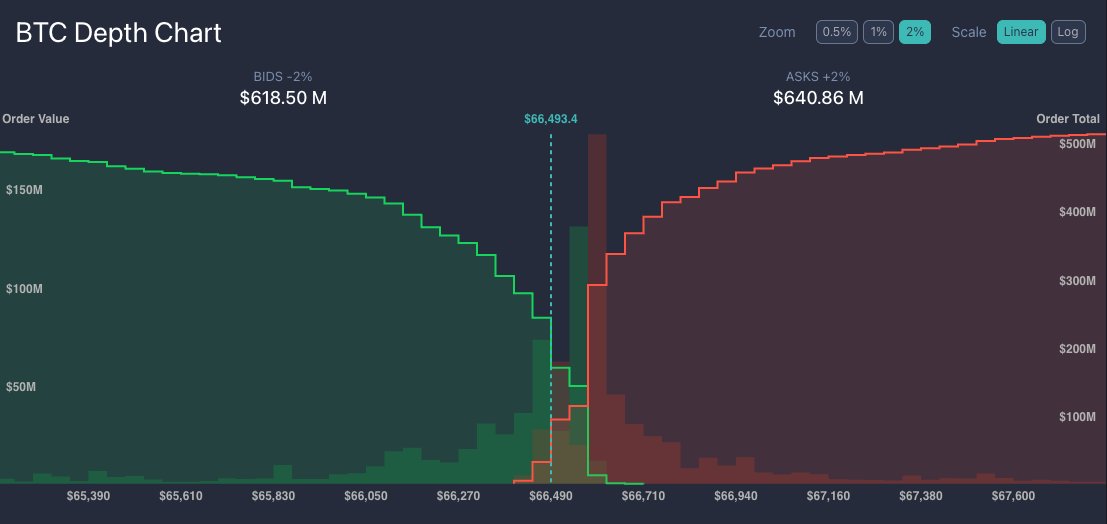
In the chart above, you’ll notice the 'liquidity walls' are much thicker than in previous years. This is due to Professional Market Makers and Automated Arbitrage Bots that keep prices aligned between decentralised exchanges (DEXs), centralised exchanges (CEXs), and the new Spot ETFs. A 'healthy' 2026 depth chart shows a dense, symmetrical 'valley' where the green (buys) and red (sells) meet, indicating that even massive institutional trades won't cause the price to 'skip' levels.
Factors That Influence Crypto Liquidity
Multiple factors contribute to the overall liquidity of a given cryptocurrency. We’ve outlined some of these factors below.
Popularity
Popular cryptocurrencies are generally highly liquid due to the vast volume traded every day. They are also in high demand and supply by both small and large investors, further contributing to their high levels of liquidity.
Number of Exchange Listings
Popular cryptocurrencies are typically driven by active development teams, passionate communities, and strong, real-world utilities — all of which are key determinants of the market demand for a cryptocurrency. Nonetheless, as a cryptocurrency becomes more popular, it will likely be listed on more exchanges.
A higher number of exchange listings increases the overall liquidity of a cryptocurrency. This is because it enables investors and traders to choose from several different markets when buying or selling a specific cryptocurrency, allowing them to access the best price.
Market Making
Market makers refer to individuals or broker-dealers that profit by providing liquidity to the rest of the market. They “make the market” by ensuring that traders can always buy and sell at a fair price. This is done by actively quoting both sides of the market and providing bids and offers. Market makers boost overall liquidity and market depth.
Market Capitalisation
Market capitalisation (also referred to as market cap) is a metric that measures the relative size of a cryptocurrency. It is calculated by multiplying the total number of coins in circulation by the current price of that specific coin.
Market capitalisation is one of the best ways to check for liquidity, as large market cap cryptocurrencies tend to have higher demand. Alternatively, low-market-cap cryptocurrencies have lower liquidity because demand for the cryptocurrency is comparatively lower.
Liquidity Versus Volume
The difference between trading volume and liquidity is widely misunderstood in the cryptocurrency market. Trading volume represents the number of executed trading transactions, whereas liquidity represents the number of available trades at any given price. Both are often quoted in dollar or fiat value terms.
Liquidity: It Matters
Generally, traders and investors are inclined to trade markets with high levels of liquidity, as they’re less likely to encounter obstacles and irregularities when entering or exiting their positions. Given the volatile nature of the crypto market, liquidity is often an important consideration for people when they select digital assets. More conservative traders will almost always assess the liquidity of a cryptocurrency market and avoid trading less liquid assets in order to conserve their capital.
FAQs
Q: Which crypto has the most liquidity?
A: Globally, bitcoin is known to be the most liquid cryptocurrency. However, Ethereum (ETH) and Solana (SOL) have closed the gap significantly in 2026 due to their own ETF approvals and high-frequency DeFi trading volumes.
Q: Can you sell crypto with low liquidity?
A: Cryptocurrencies with low liquidity can be bought and sold, but it won’t necessarily be easy. Buying cryptocurrencies with low liquidity can take more time, and the executed price may deviate further from the desired buy price.
Q: Is crypto more liquid than stocks?
A: The "Big Three" (BTC, ETH, SOL) are now as liquid as mid-to-large cap stocks. While the total stock market is still larger, Bitcoin's 24/7 global trading means it can actually be more liquid than many stocks during weekends or holidays when traditional markets are closed.
Q: Can I sell crypto instantly if I use a broker?
A: Yes. Professional brokerages like Caleb & Brown leverage "Global Liquidity Aggregators." This means we tap into dozens of liquidity pools simultaneously to ensure your order—no matter the size—is executed at the best possible market price with minimal slippage.
Make Your First Investment With Caleb & Brown
You don’t have to be an expert to start investing in crypto.
Caleb & Brown is the world's leading crypto brokerage for both beginner and advanced investors, making your entry into the market effortless.
Our personalised broker service makes crypto investing simple. A dedicated member of our broker team is always on hand to guide you along the way, giving you the confidence you need to navigate the world of crypto.
Not to mention key features such as:
- No joining or sign up costs
- Industry-leading storage solutions
- 24/7 customer support
If you're ready to take the next step and invest, contact your Caleb & Brown broker today. Not yet a client? Sign up for your free consultation.
from Caleb & Brown Cryptocurrency Brokerage.


