
.webp?u=https%3A%2F%2Fimages.ctfassets.net%2F4ua9vnmkuhzj%2FuIaUbUNRbO1LdljRWKvoI%2Fd93965ff275cd47f8c19fcc71edcd42e%2FBitcoins_Market_Cycle_V3-01__1_.jpg&a=w%3D3840%26h%3D2160%26fm%3Dwebp%26q%3D80&cd=2023-02-21T06%3A17%3A39.793Z)
Key points
-
Bitcoin’s market cycle refers to the recurring pattern of price behaviour in the bitcoin market, characterised by alternating periods of appreciation and depreciation.
-
The cryptocurrency has historically followed a four-year cycle tied to Bitcoin halving events, which happen approximately every four years.
-
A Bitcoin halving event marks a 50% cut in the bitcoin reward miners receive for mining new blocks and verifying transactions.
-
Aside from monitoring bitcoin’s price and trading volume, indicators, such as the crypto Fear and Greed Index, exchange reserves, search interest in bitcoin, and macro correlation can help traders and investors understand bitcoin’s market sentiment.
What is the Bitcoin Market Cycle?
A Bitcoin market cycle is the recurring sequence of price expansion (bull markets) and contraction (bear markets) driven by investor sentiment, adoption, and macroeconomic shifts. Typically lasting four years around block reward halvings, the cycle moves sequentially through four stages: accumulation, growth, euphoria, and distribution.
Historically, bitcoin has followed a four-year cycle tied to Bitcoin halving events, which happen approximately every four years. A halving event marks a 50% cut in the bitcoin reward miners receive for mining new blocks and verifying transactions. In effect, the bitcoin supply continues to increase, but at a slower rate, upholding the network’s deflationary principles. The knock-on effect has led to steep price increases, driven by speculation and a decrease in the supply of new bitcoin entering circulation. The last halving occurred on April 19, 2024, when the block reward decreased from 6.25 to 3.125 bitcoins. The next halving is expected in April 2028.
What are the Bitcoin Market Cycle Phases?
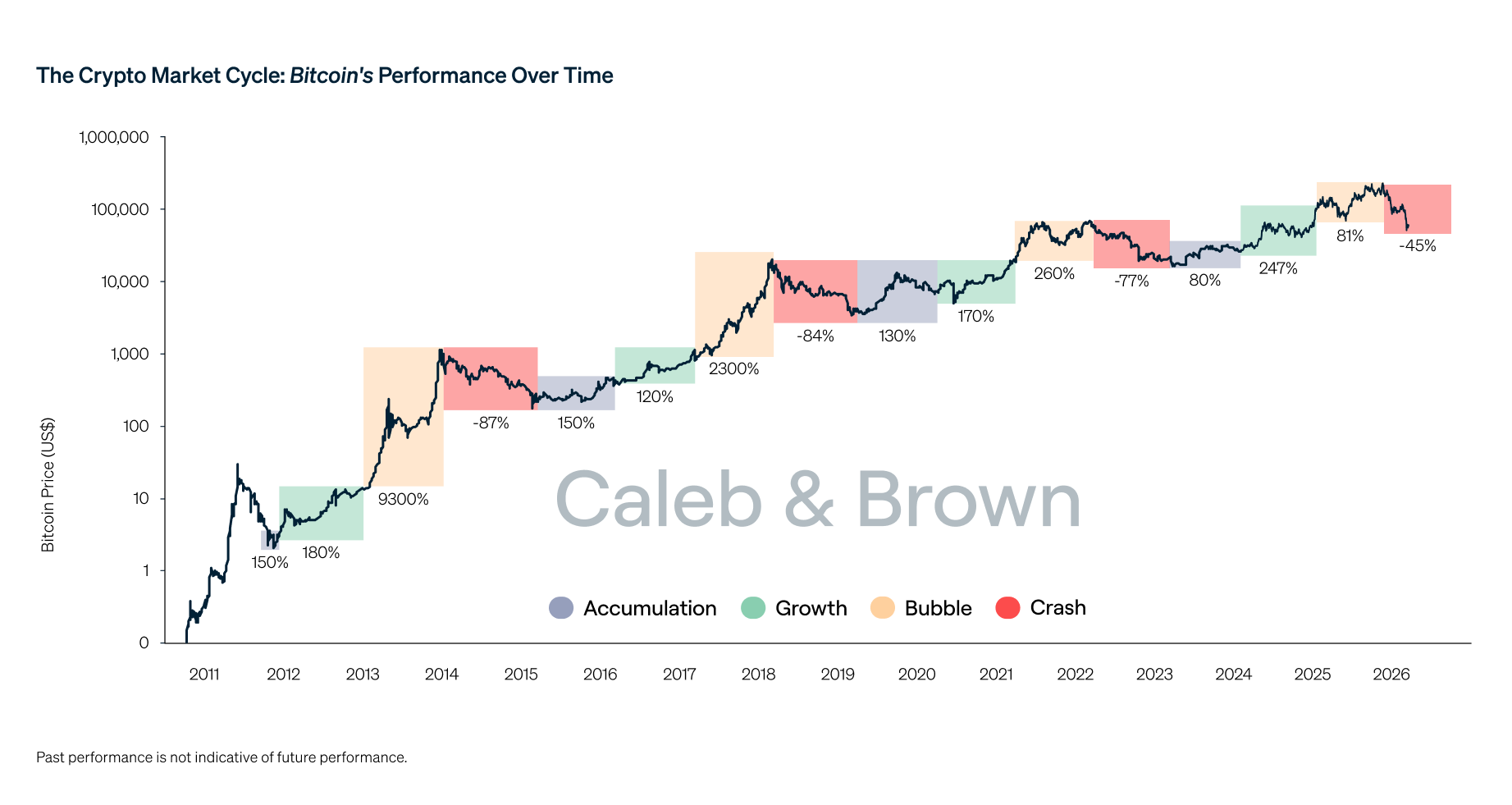
The chart below illustrates the cyclical nature of bitcoin’s price and its historical trends.
Phase 1 – Accumulation
The accumulation phase of the bitcoin market cycle occurs when prices are (relatively) low, but small signs of growth appear. During this phase, forward-thinking buyers will accumulate cheaper bitcoin as it represents the point of maximal upside.
Typically, there is bearish sentiment in the market, so volume is low and prices fluctuate in a tight range near the bottom.
Phase 2 – Growth
In bitcoin’s growth phase, price continues moving towards the all-time high. Halving events in the past have occurred here, coinciding with shrinking exchange reserves as buyers absorb supply in anticipation of capturing rising prices and new all-time highs.
Phase 3 – Bubble
In the bubble phase of the bitcoin market cycle, the price eclipses the previous all-time high and begins to move exponentially to the upside. These higher prices typically exceed the previous highs by a significant amount. The bitcoin bubble phase is extremely volatile, characterised by rapid price increases followed by significant corrections.
Sell volume builds as a portion of investors lock in healthy profits, while many market participants continue to buy, believing the bull market has more room to run. As a result, price volatility is low given that buy and sell volumes begin to balance against a backdrop of overconfidence. At this point, the Fear & Greed Index typically flashes Extreme Greed.
Phase 4 – Crash
Following the euphoria of the bubble phase, the market will experience a major correction to the downside. Previous bear market periods have resulted in approximately 80% drawdowns from the top and negative price action for approximately a year. The most recent example saw the price tumble by almost 78% from an all-time high of US$69,000 in November 2021 to US$15,476 in November 2022.
In the current cycle, bitcoin hit a new all-time high of US$126,296 on October 6, 2025. Since then, price has declined by 46.7% to trade around US$67,550 in mid February 2026.
Understanding Sentiment through Historical Bitcoin Cycle Patterns
Aside from trading volume and indicators, such as the Fear and Greed Index, there are other indicators that can help traders and investors understand bitcoin’s market sentiment.
Getting an Indication of Price through Bitcoin Exchange Reserves
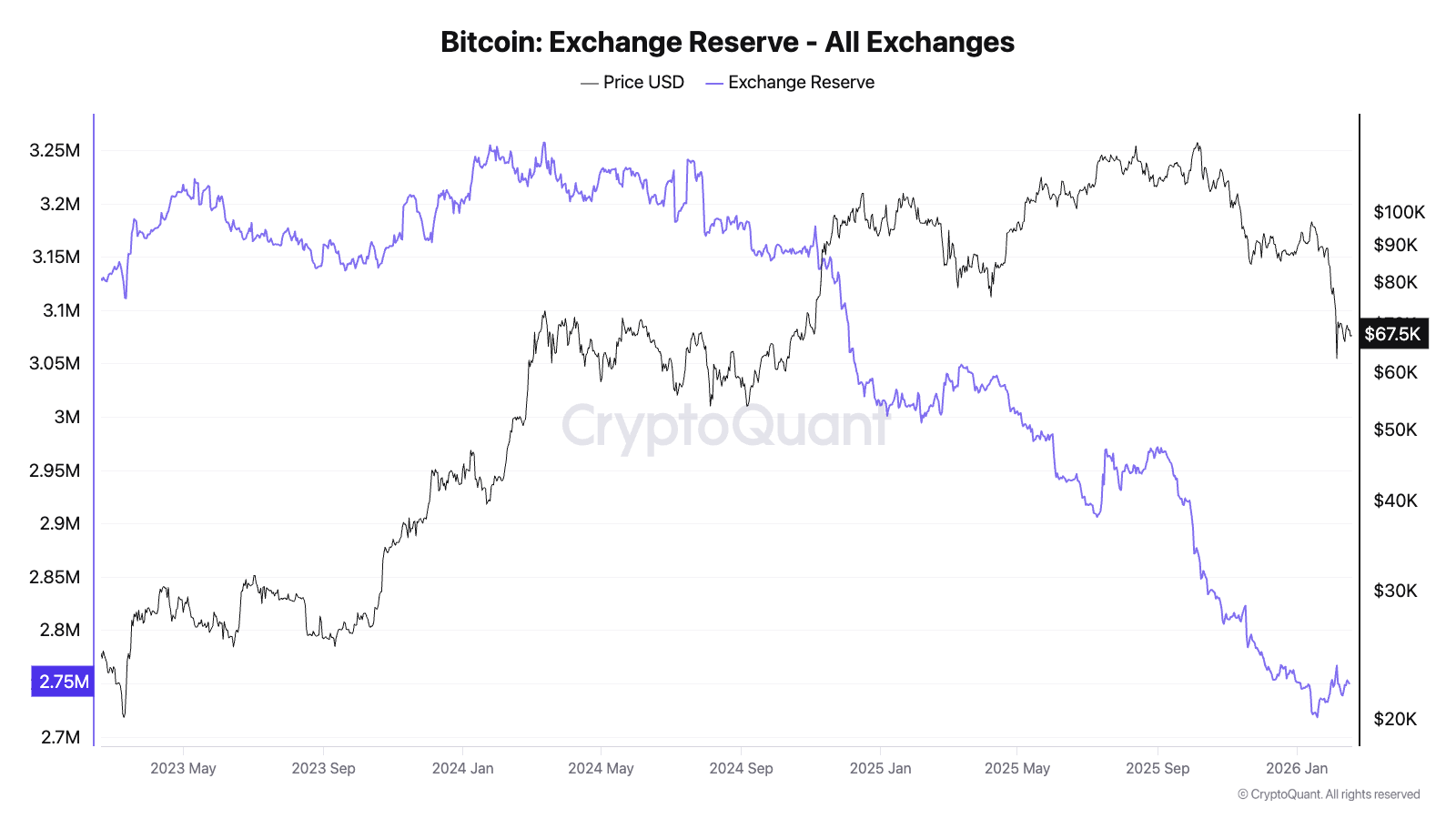
Before bitcoin reaches new highs, the amount of bitcoin held in central exchange wallets is typically low, indicating that investors may be holding their BTC and waiting for higher prices. This HODLing reduces available supply (even further in a high-demand period) and, as seen below, this can result in sharp price increases.
Identifying Market Cycle Phase with New Interest in Bitcoin
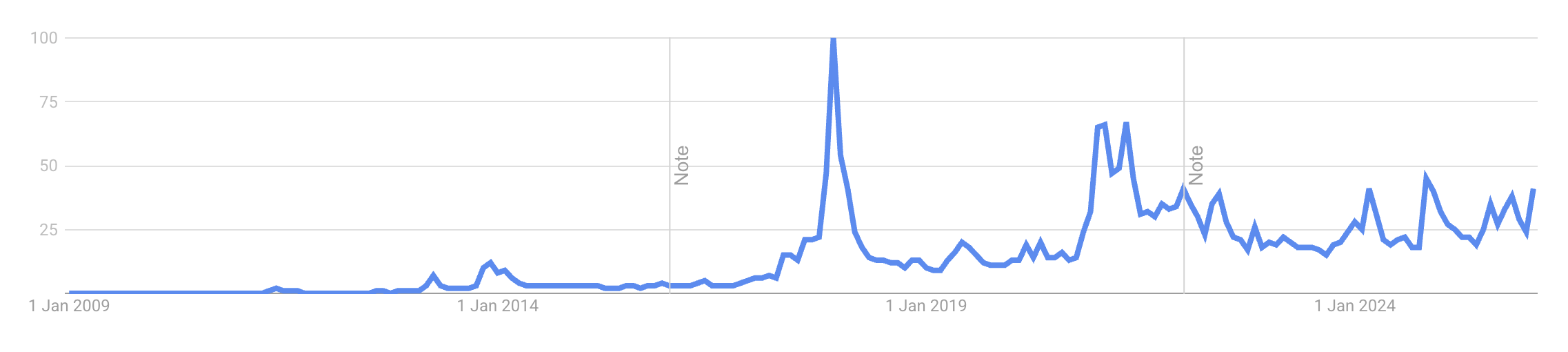
Peak interest in bitcoin, as measured by Google search activity, was reached in December 2017, coinciding with the bull market’s run-up to an all-time high. Since then, Google Trends shows that the search volume for 'bitcoin' hasn’t reached the same levels as the 2017 bull run, despite delivering multiple all-time highs since.
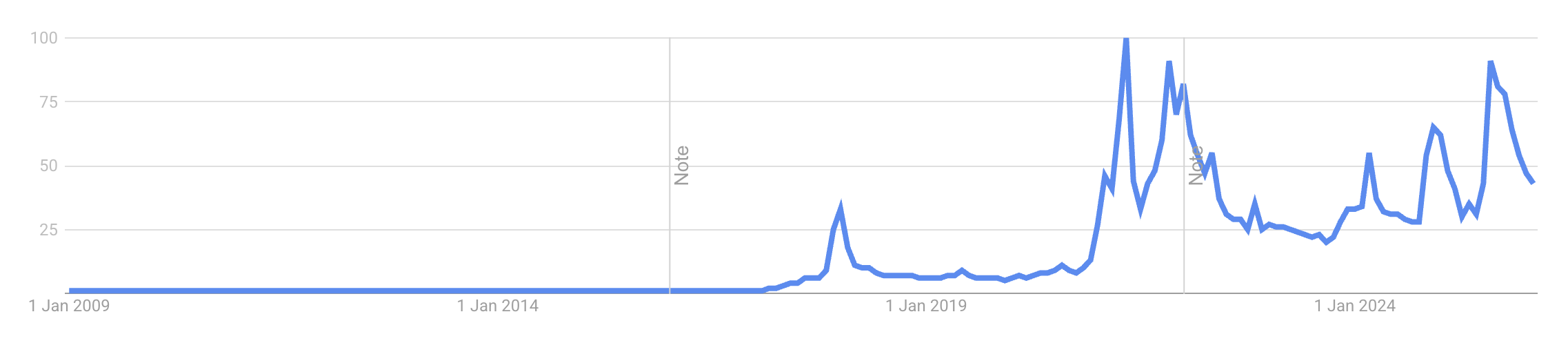
Similarly, Google search volume for ‘crypto’ peaked during the 2021 bull run, though it did reach 96 in August 2025, when the crypto market experienced a rally. The most-recent spike in search volume suggests that, while attention is now focused on the entire ecosystem, and market participants may get information without specifically searching “crypto,” a strong rally still sees a spike in retail interest like previous bull markets.
Macro & Bitcoin Correlation
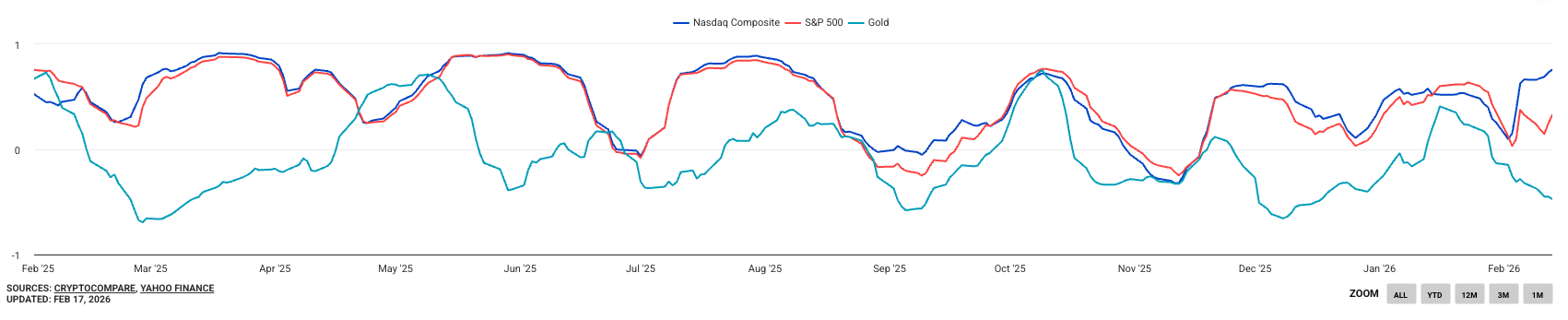
The relationship between Bitcoin and the S&P 500, referred to as a correlation, shifts based on broader market sentiment. Throughout 2025, a pattern has emerged in which bitcoin’s price is highly correlated with risk assets, such as those held in the S&P 500 and Nasdaq Composite (Nasdaq), when risk-off sentiment prevails. For example, in April 2025, following the announcement of President Trump’s tariffs, the correlation between bitcoin and the S&P 500 and Nasdaq reached 0.73 and 0.76, respectively. As geopolitical uncertainty in the Middle East persisted throughout May and June 2025, bitcoin’s correlation with both the S&P 500 and the Nasdaq hovered around 0.90. And in the October 10 crypto crash that saw over US$19 billion of liquidations, the correlation between bitcoin and the S&P 500 and Nasdaq reached 0.77 and 0.77, respectively.
It's important to recognise that correlations can change over time, and the relationship between bitcoin’s price movements and other asset classes can be influenced by various factors, including macroeconomic events, geopolitical uncertainty, and regulatory developments. However, at this point in time, noting bitcoin’s correlation with the major U.S. indexes can be helpful in determining overall crypto market sentiment.
Is bitcoin’s correlation with the S&P 500 and Nasdaq declining?
Since the October 10 crypto crash and into the start of 2026, bitcoin’s price has continued to decline. It reached a local high of US$97,963 on Wednesday, January 14, 2026 and then sold off in the following weeks to a low of US$60,001 on Friday, February 6, 2026. Sentiment declined to extreme fear, at levels not seen since the collapse of Terra Luna in May 2022. Several catalysts converged that increased sell pressure, including leveraged liquidations which can cause larger market swings, macroeconomic uncertainty around the U.S. Federal Reserve’s interest rate trajectory, and slow progress on crypto regulation, particularly the Clarity Act, which remains before the Senate in February 2026.
Throughout this time, risk assets continued to climb higher, raising the question of whether bitcoin’s four-year cycle had ended or if it was a sell off in a potential extended cycle. There are valid arguments for both cases, though current bearish sentiment would need to turn around, along with macro catalysts such as U.S. interest rate cuts, sustained weakness in the U.S. Dollar, and easing monetary policy to make market participants more comfortable with allocating liquidity further down the risk curve.
Check out our deep dive: Is bitcoin’s four-year cycle broken?
Like periods throughout late 2025 and into 2026, when volatility increased and crypto risk assets sold off as TradFi assets made gains, monitoring bitcoin’s correlation with TradFi can be an indicator of broader crypto sentiment.
Mainstream Adoption of Bitcoin
Several recent developments have seen adoption in the growth of bitcoin as both a store of value and legal tender. These developments are outlined below.
Public Companies Buying Bitcoin
Mainstream adoption of bitcoin has been on a steep curve. In January 2018, the value of BTC trading on Binance surpassed $11 billion – a fraction of the bitcoin traded on the platform in March 2024, when the exchange saw over $1trillion worth of volume across all assets. Over this period, bitcoin has proven itself to a growing community of retail and, crucially, institutional investors, including exchange-traded fund (ETF) issuers, governments, and public and private companies. As of February 2026, corporate treasuries held over 8.4% of total BTC supply. The largest publicly traded holder of bitcoin is Microstrategy, which currently holds 717,000 BTC, purchased at an average price of $76,027 per bitcoin. Notably, Strategy’s bitcoin holdings are at a paper loss, at the time of writing, as bitcoin has traded below the company’s average BTC purchase price since early February, 2026.
Bitcoin Exchange-Traded Funds
Bitcoin’s mainstream adoption has grown following the successful launch of over ten Bitcoin Spot ETFs. For those seeking exposure to bitcoin through traditional finance institutions and wealth management firms, bitcoin ETFs offer an option that may be more accessible to those less familiar with crypto technology. However, for crypto natives and those interested in the privacy that crypto offers, buying bitcoin through a broker or exchange and transferring these holdings to a cold wallet is the optimal approach. This approach is what gave rise to the saying, “not your keys, not your coins,” in the crypto community.
Regulatory Developments
Governments worldwide have increased their regulatory efforts to establish a clear framework for the cryptocurrency sector. In June 2021, El Salvador became the first country in the world to adopt bitcoin as legal tender. The country's legislature approved a law that requires businesses to accept bitcoin as a form of payment for goods and services, and also established a BTC reserve through purchasing bitcoin using the country’s funds. El Salvador’s BTC reserve currently stands at 7,475 BTC, with an average purchase price of US$67,741.
Crypto regulation was a key policy area for President Trump in the 2024 presidential election, and several regulatory developments have occurred since his inauguration in January 2025. In early 2025, President Trump made an executive order to create two new government-managed funds for digital assets: a Strategic Bitcoin Reserve (SBR) and a U.S. digital assets stockpile. At this stage, these digital asset reserves will be capitalised with crypto assets seized in criminal forfeiture. Bills to establish other digital asset reserves, where the Federal Government may use public funds to acquire bitcoin and other digital assets, are currently before Congress in varying stages of progress.
Three U.S. states have enacted laws to establish a Strategic Bitcoin Reserve (SBR) using public funds: Arizona, New Hampshire and Texas. There are currently 19 SBR bills live across eight states, while nineteen states voted against SBR bills. In November 2025, Texas became the first U.S. state to buy bitcoin. State officials executed the transaction, buying US$5 million worth of BlackRock’s spot bitcoin ETF. While it’s a relatively small amount, the purchase indicates the State’s commitment to adding bitcoin to its long-term treasury planning.
Other key pieces of legislation expected to provide regulatory clarity to the crypto sector, which could potentially drive upward price momentum, are the GENIUS Act (the U.S. Senate’s stablecoin bill) and the Digital Asset Market Clarity, or CLARITY Act. Stay up-to-date on the latest developments in crypto regulation and the current market with our Weekly Rollup.
Bitcoin as Legal Tender
Beyond investors, several large companies accept bitcoin as payment, including PayPal, Microsoft, Shopify, and Chipotle, among others. This trend is expected to continue growing as crypto adoption becomes increasingly mainstream. In November 2025, Block (formerly Square), led by Jack Dorsey, enabled BTC payments for around four million Square merchants. Transactions settle instantly via Bitcoin’s Lightning Network, and sellers can optionally convert payments to fiat. Block is waiving all processing fees through 2027 to accelerate adoption. This trend is expected to continue growing as crypto adoption becomes increasingly mainstream.
Recommended reading: Crypto Portfolio Basics: The Key to a Well-Balanced Portfolio
Frequently Asked Questions About the Bitcoin Cycle
How long does a Bitcoin market cycle last?
Historically, a Bitcoin market cycle lasts approximately four years (roughly 48 months). This schedule aligns with the protocol's 210,000-block halving schedule, which slashes block rewards in half every four years.
Which market cycle phase is best for buying Bitcoin?
The Accumulation phase (Phase 1) is generally viewed by long-term investors as the optimal entry point, as prices trade in a tight lower range relative to network fundamentals prior to a major bull market expansion.
How do exchange reserves signal market cycle tops and bottoms?
Low or declining exchange reserves indicate that investors are transferring coins to long-term cold storage (bullish supply shock). High or rising exchange reserves signal that investors are preparing to sell or trade, increasing sell-side pressure (bearish).
Buy Bitcoin with Caleb & Brown
You don’t have to be an expert on bitcoin's market cycle to trade the original and largest cryptocurrency.
Caleb & Brown is the world's leading crypto brokerage for beginner and advanced investors alike, with bitcoin and hundreds of other crypto assets readily available for your portfolio.
Our personalised broker service makes crypto investing simple. A dedicated member of our broker team is always on hand to guide you along the way, giving you the confidence you need to navigate the world of crypto. Not to mention key features such as:
- One flat, transparent fee
- 300+ crypto assets available to buy, sell, and swap
- 24/7 client support from humans
If you're ready to take the next step and invest, contact your crypto broker today.
Not yet a client? Sign up for your free consultation.
from Caleb & Brown Cryptocurrency Brokerage.


.webp?u=https%3A%2F%2Fimages.ctfassets.net%2F4ua9vnmkuhzj%2F7meVnT2vnQelBrt6W5yw73%2F8469fbdea8168e404fff363b35dd65a4%2FBitcoin_Halving-01__1_.jpg&a=w%3D3840%26h%3D2160%26fm%3Dwebp%26q%3D80&cd=2023-01-10T02%3A22%3A06.649Z)


