

In this Week's Market Rollup
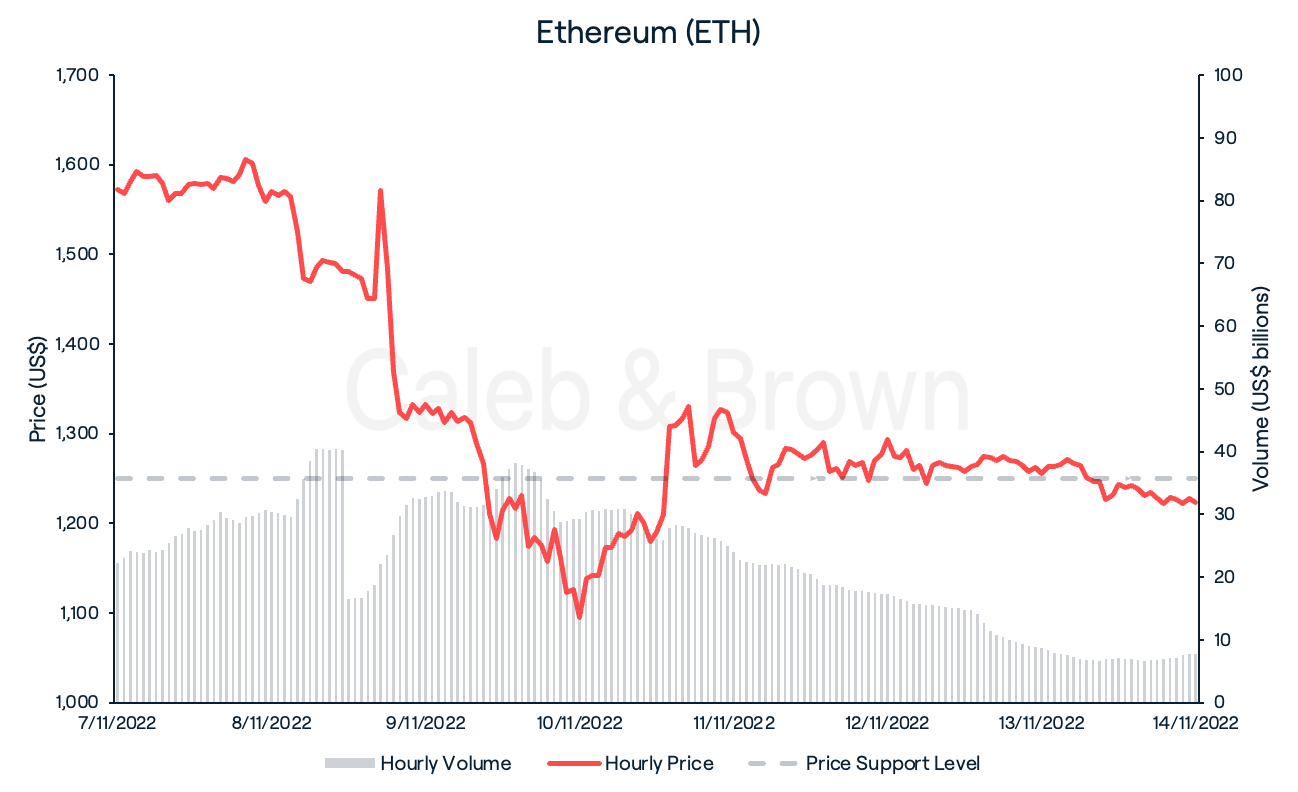
They say there’s never a dull moment in crypto, and the past seven days has been no exception. Just as the cold of crypto winter looked to be potentially thawing, the industry bore witness to one of the most dramatic collapses in its history. The sudden fall of FTX, one of the world’s largest crypto exchanges, sent shockwaves across the market with prices spiralling down across the board over the past week. Both Bitcoin (BTC) and Ethereum (ETH) lost over 20% of their value, while most other assets were hit even harder.
Market Highlights
- FTX, a major centralised exchange, declares Chapter 11 bankruptcy, triggering a wave of broader market sell-offs. The FTX Token (FTT) is down nearly 95% over the last seven days.
- Caught in the mess, BTC tumbled below US$16,000 for the first time since November 2020.
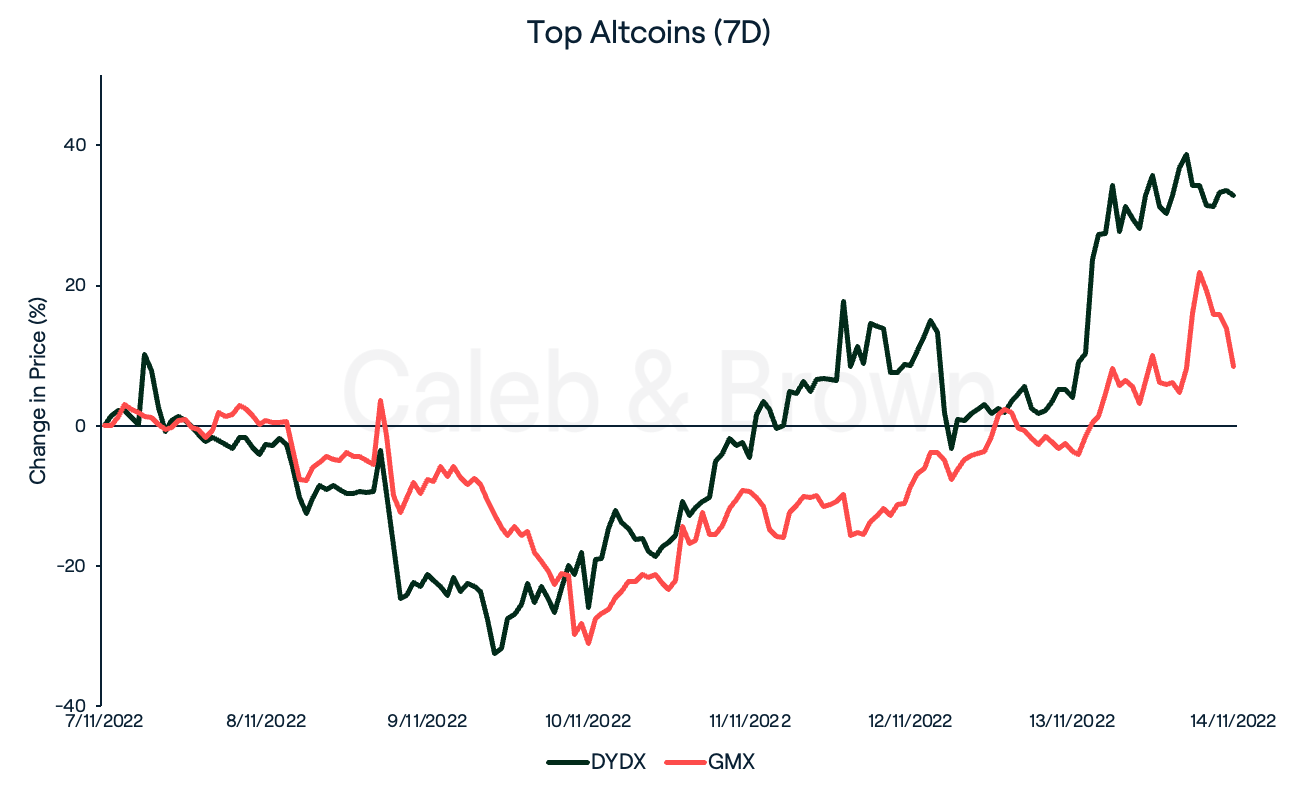
- In the wake of failing centralised platforms, two decentralised perpetual exchanges have absorbed relative volume and market share. dYdX (DYDX) and GMX (GMX) in particular benefited from the recent events, gaining 23.7% and 8.3%, respectively.
What the FTX? The Meltdown Explained
It has been an volatile week to say the least. In less than seven days, FTX has gone from being one of the largest and most reputable brands in the crypto industry to filing for bankruptcy. But how did this unfold?
On November 7, Binance CEO Changpeng “CZ” Zhao declared he would move to liquidate his exchange’s entire FTT holdings (FTT is FTX’s native token) following revelations that FTX’s CEO, Sam “SBF” Bankman-Fried, was allegedly lobbying “against other industry players behind their backs.”
CZ’s tweet caused a bank run as FTX customers began withdrawing funds from the exchange en masse. In less than 72 hours, over $6 billion was withdrawn from the exchange. While SBF claimed all “assets were fine” in a now-deleted tweet, FTX was forced to suspend withdrawals, causing further panic amongst investors.
Insolvent and unable to process withdrawals, CZ announced on Tuesday, November 9, that Binance was looking to bail out FTX in a tentative agreement to acquire the company. However, the following day, CZ announced that “FTX was beyond our ability to help.” In a tweet, Binance attributed its U-turn to the “latest news reports regarding mishandled customer funds and alleged US agency investigations.”
The crisis concluded on November 12 with the news that FTX had filed for Chapter 11 bankruptcy alongside approximately 130 additional affiliated companies. The press release also brought news of SBF’s resignation as CEO and the appointment of veteran bankruptcy lawyer John J. Ray as the new CEO of FTX.
Price Movements
Bitcoin (BTC)
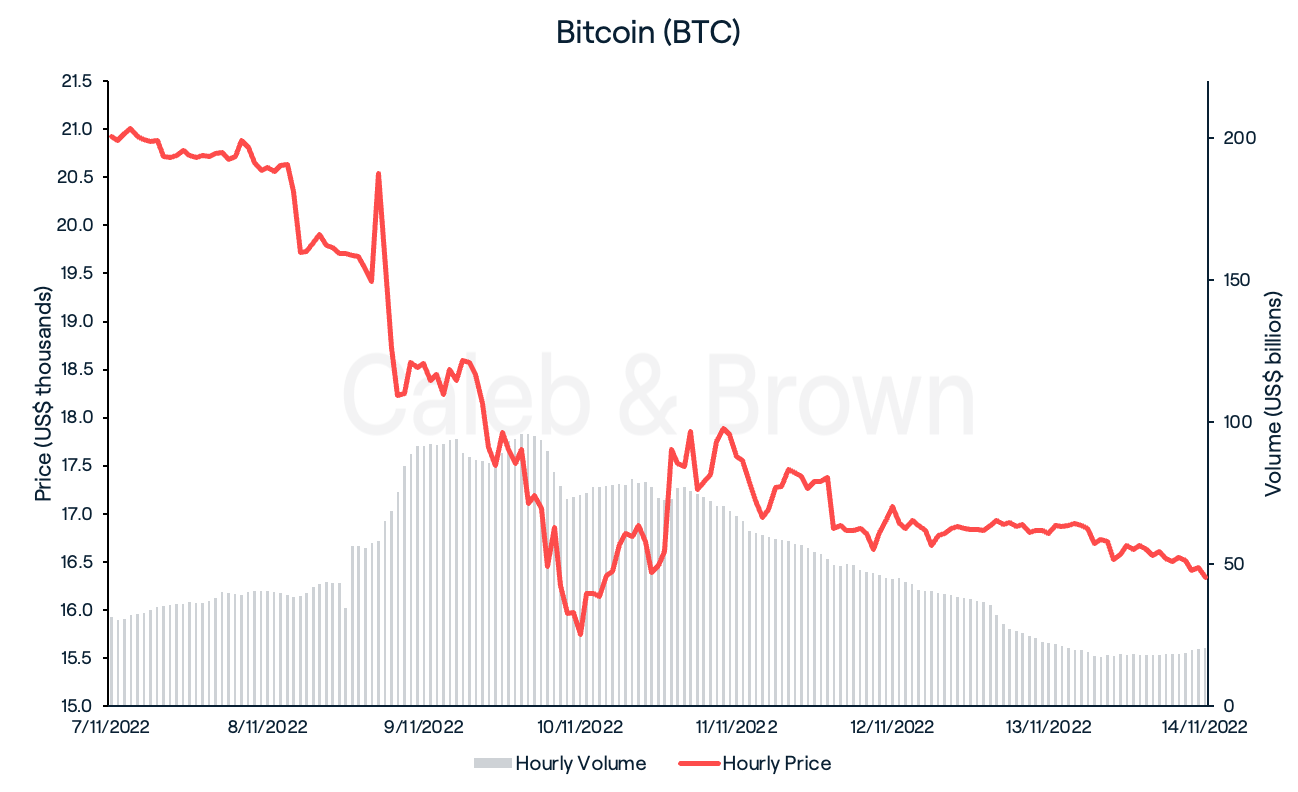
The latest report from the Bureau of Labor Statistics revealed that the CPI had risen 0.4% for the month and 7.7% over the last 12 months, both lower than the estimated rates of 0.5% and 7.9%, respectively. While this sits well above the Federal Reserve’s 2.0% to 3.0% annual inflation target, investors responded positively to the news as BTC and the rest of the market rallied over the next 24 hours, allowing for a small but short-lived sense of relief in what had been a bloodbath of a week.
Ethereum (ETH)
Altcoins
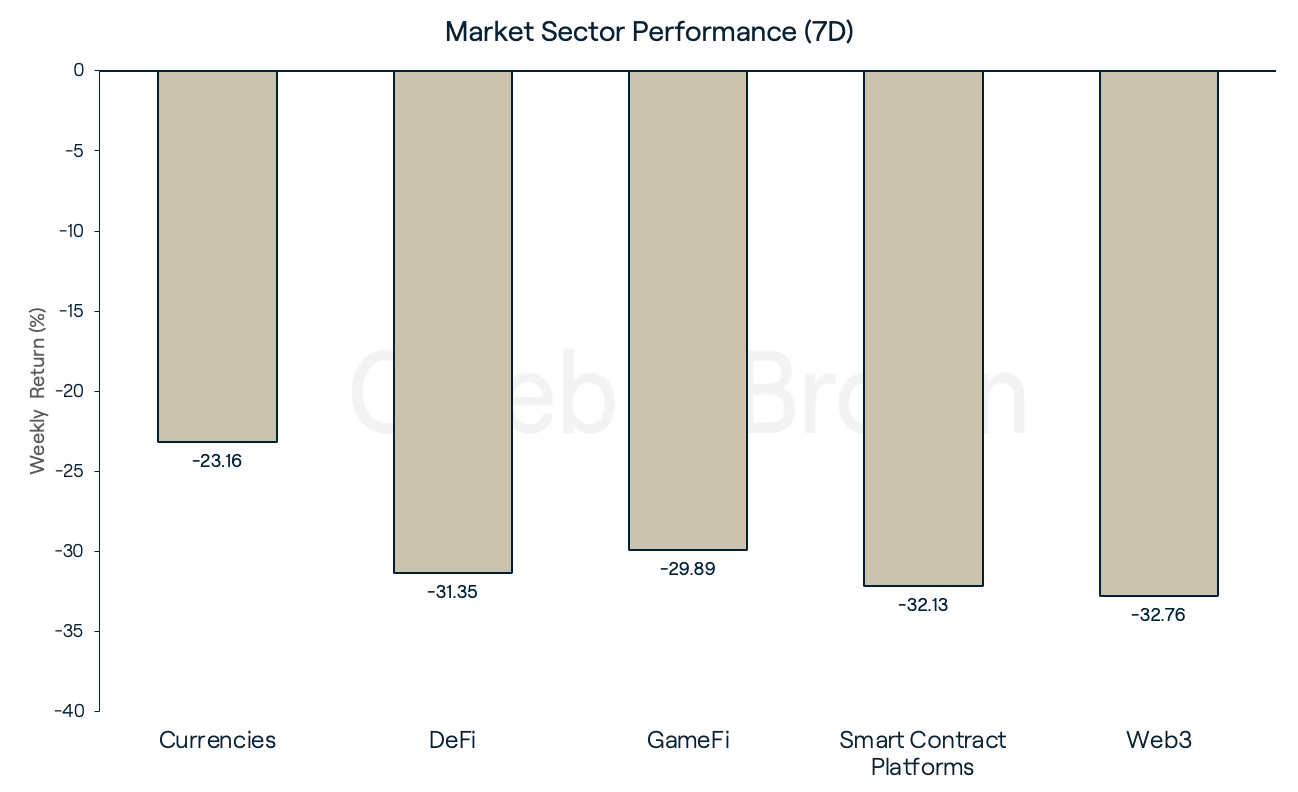
Most of the worst-hit assets this week were either directly or indirectly linked to FTX. FTX’s native token, FTT, has been hit the hardest, losing nearly 95.0% of its value over the last seven days. The most significant loss in the top fifty cryptocurrencies was felt by Solana (SOL) holders, who saw their holdings fall by 47.0%. Sam Bankman-Fried (SBF), the ex-CEO of FTX, was one of Solana's first investors. SOL was the second largest holding of SBF’s now-collapsed hedge fund, Alameda Research.
Recommended reading: Caleb & Brown's Approach to Risk Management and Client Protection
from Caleb & Brown Cryptocurrency Brokerage.


