


Market highlights
- MARA Holdings sold US$1.1 billion of BTC to buyback convertible debt at a discount.
- BitMine’s Made in America Validator Network launched for institutional clients.
- Latest draft of the CLARITY Act still bans stablecoin yield on balances.
- White House crypto adviser David Sacks’ appointment reached its 130-day term limit.
- NYSE has partnered with Securitize to build infrastructure for tokenised securities.
- Coinbase has partnered with home lender, Better, to enable crypto-backed mortgages.
Macro market overview
Further weakness plagued TradFi markets as the Iran war entered its fifth week, a resolution appears unlikely at this point in time, and more U.S. troops were deployed to the region. The major U.S. indexes closed the trading week at their lowest levels in seven months, marking a fifth straight week of declines from the early February highs seen across TradFi risk assets. In contrast, bond yields gained throughout the week, with the U.S. ten-year yield closing at 4.4%, while the two-year yield gained to almost 3.9%. Gold and silver traded sideways this week, and oil prices rose again, landing at US$104.65 per barrel.
In economic data, the flash manufacturing and services purchasing manager index (PMI) updates from around the world came in mixed. Germany, the U.K., and the U.S. each saw an above forecast reading for their manufacturing PMI, while the services PMI came in around 1.2 points lower than expected in each country. The manufacturing PMI results reflect the immediate impacts of the Iran war, with purchasing manager’s experiencing higher prices on inputs to produce goods. Should these elevated production costs continue, an uptick in consumer prices may follow, meaning higher rates for longer as central banks work to keep inflation within their target ranges.
This week, market participants will presumably be watching for the U.S. ISM manufacturing PMI and the March non-farm employment change. Further developments in the Iran war will presumably move markets, too.
Weekly performance: S&P 500 -2.1%, Dow Jones -0.9%, Nasdaq -3.2%.
Looking ahead:
- U.S. ISM manufacturing PMI - Wednesday, April 1
- U.S. non-farm employment change - Friday, April 3
Crypto Market Performance
Market Cap: $2.34T (+1.5%)
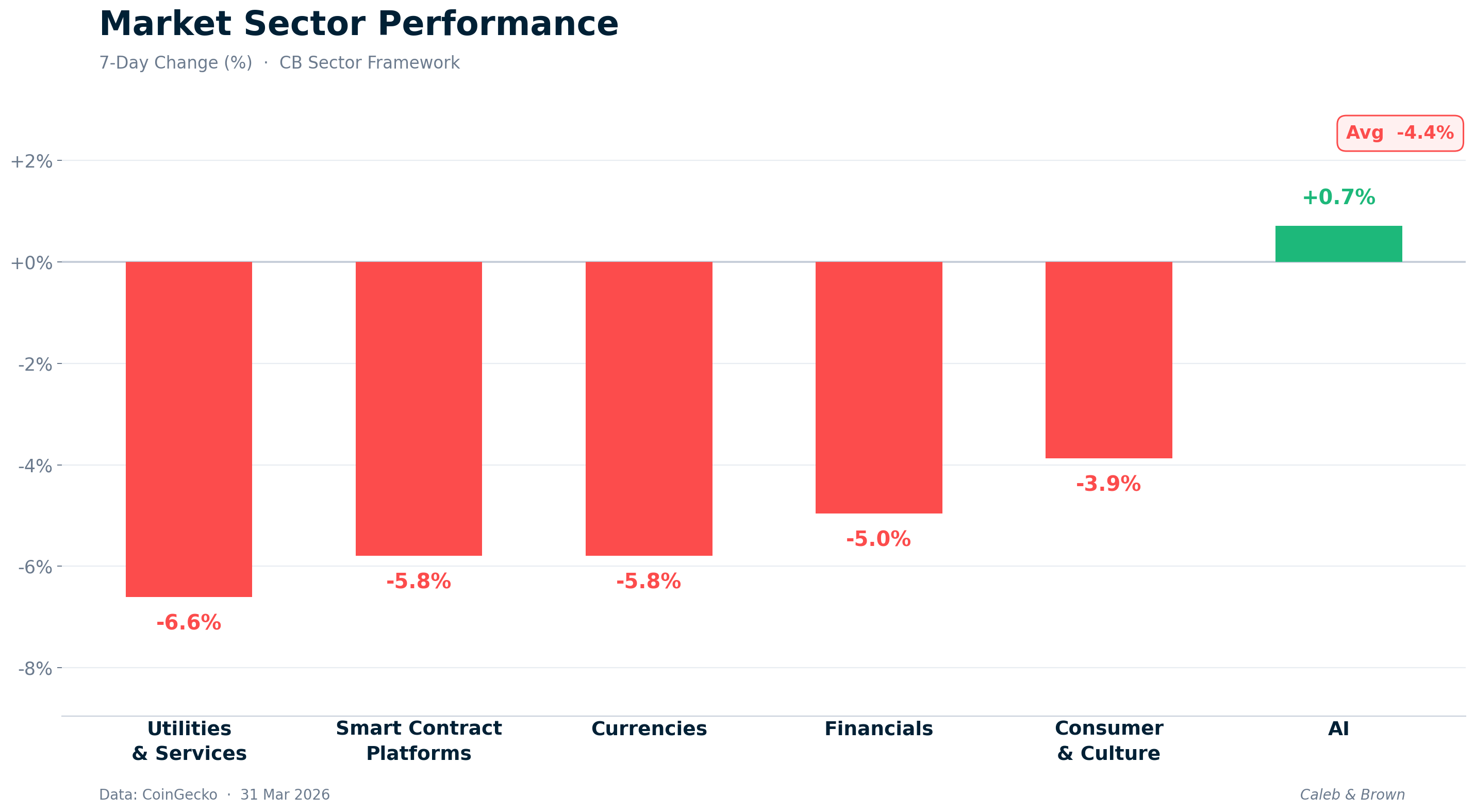
Sector performance was decisively negative this week. AI was the sole exception, positive on the back of Bittensor's +7% rally following NVIDIA's Jensen Huang's endorsement of its decentralised training network. The broad weakness reflects escalating Iran tensions, rising oil prices, and the Fed's upward inflation revision pushing rate-cut expectations further out. The crypto fear and greed index is currently in fear territory at 28.
Bitcoin (BTC)
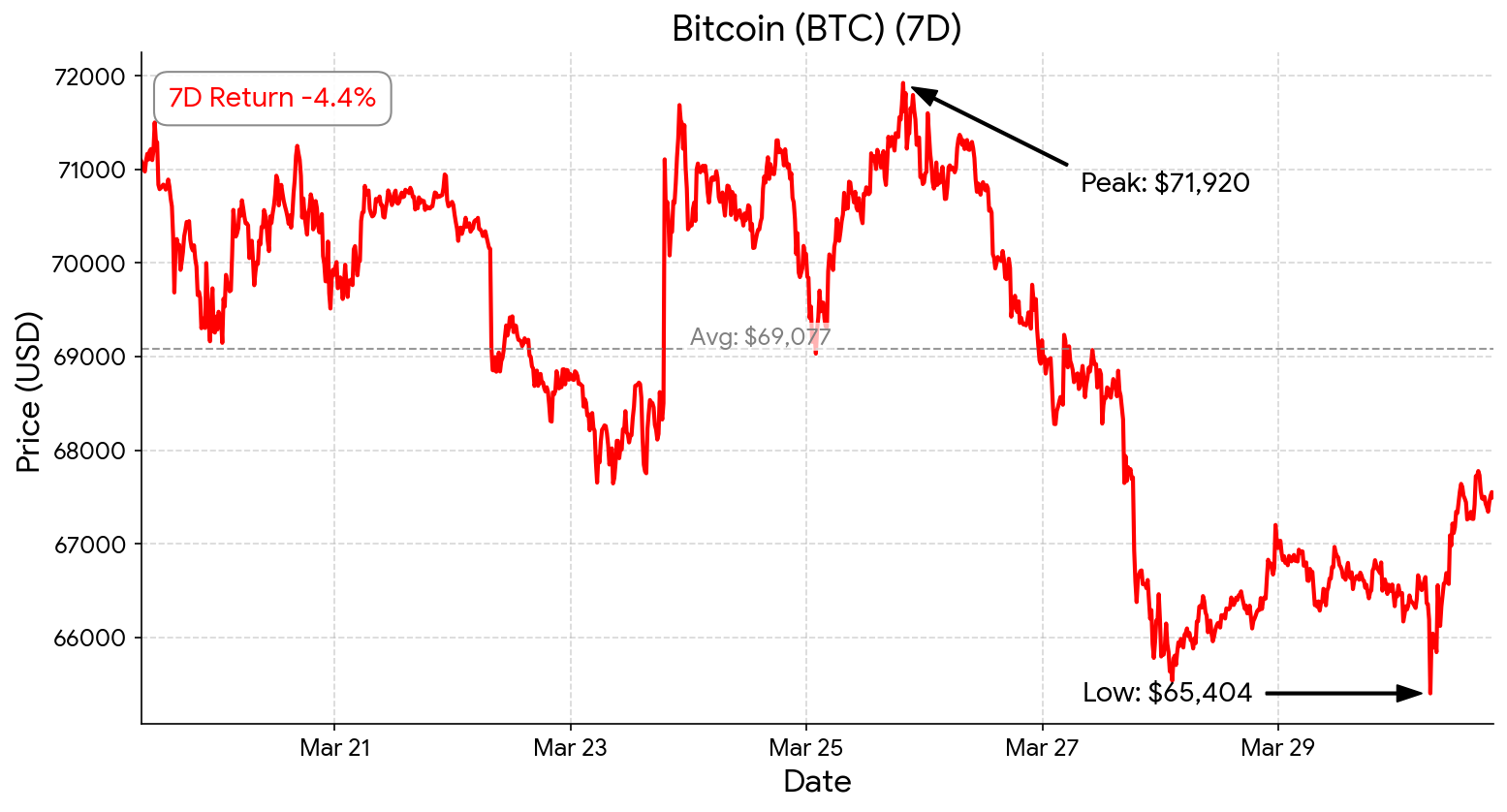
- Opened the week at US$67,844, rallied to a high of US$72,030 on Wednesday, March 25 and declined throughout the remainder of the week as geopolitical uncertainty around the Iran war causes continued risk-off sentiment. Bitcoin is now trading around US$66,750 (-1% 7D).
- BTC dominance ranged between 58.4% and 59.1% this week.
- Bitcoin investment products saw outflows of US$194 million.
Around US$13.4 billion in bitcoin options expired on March 27, with near-record open interest, driving short-term volatility as traders repositioned. The expiry set new open interest records at US$526 billion, and bitcoin declined by 4.3% on the day. Positioning skewed bearish, with heavy downside protection near $60,000, though longer-dated call options suggest expectations for a gradual recovery later in 2026 should price make a convincing break and hold above US$70,000.
Bitcoin miner MARA Holdings saw its stock rise after selling about US$1.1 billion worth of bitcoin to repurchase convertible debt at a discount and strengthen its balance sheet. The move signals a shift away from a pure “hold” strategy, as the company reallocates capital toward AI infrastructure and diversified revenue streams. In other bitcoin selling news, Bhutan reduced its sovereign holdings, moving almost 520 BTC, worth US$36.8 million to exchanges on Wednesday, March 25.
Ethereum (ETH)
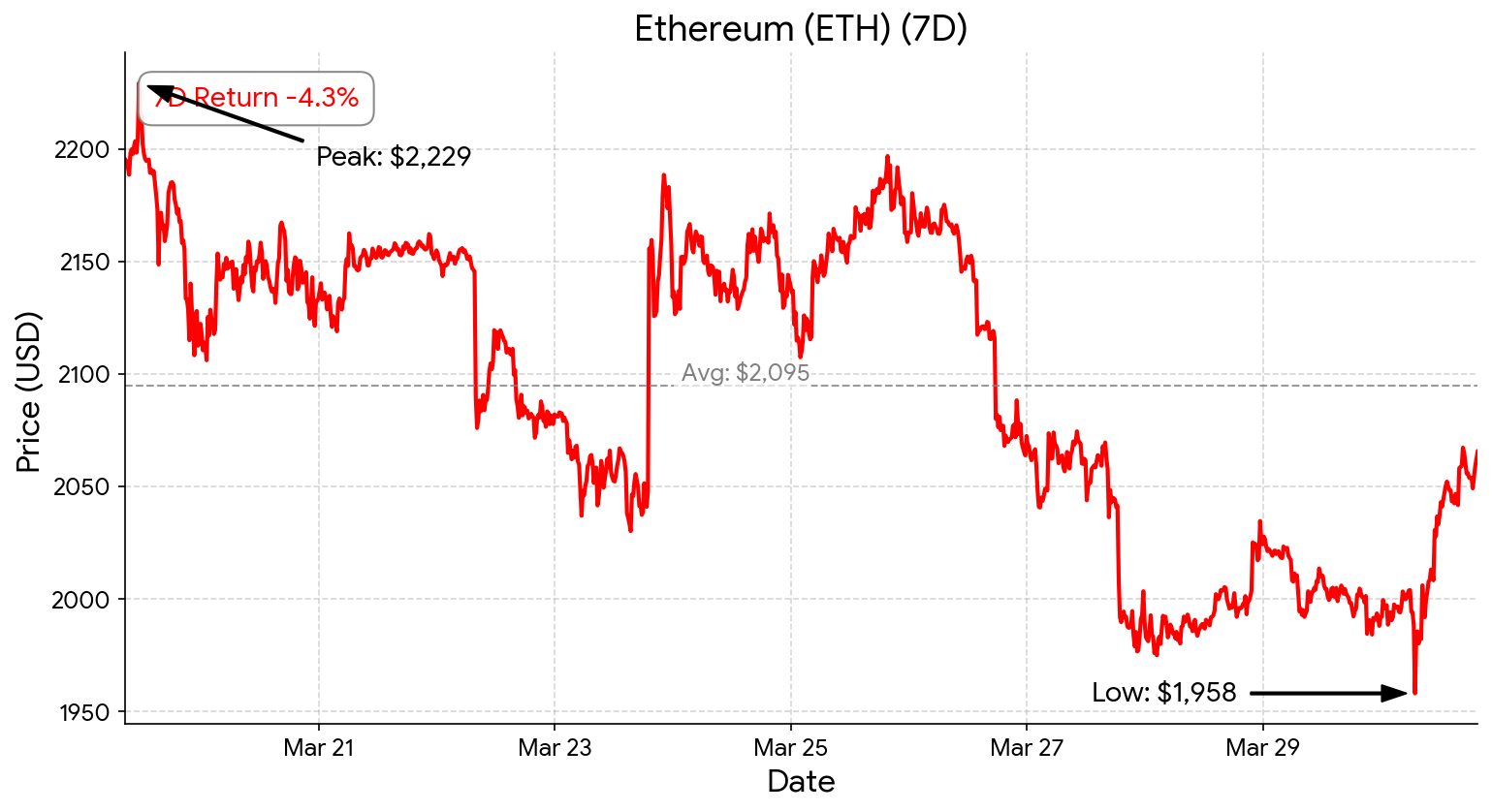
- Opened the week at US$2,053, rallied to a high of US$2,200 on Wednesday, March 25 and sold off throughout the remainder of the week on continued macro-driven risk-off sentiment. To start the new week, Ethereum is now trading around US$2,030 (-5.5% 7D).
- Ethereum dominance ranged between 10.5% and 10.9% this week.
- Ethereum-focused funds saw outflows of US$222 million.
Fundstrat’s Tom Lee has launched BitMine’s Made in America Validator Network (MAVAN), an Ethereum staking platform designed to generate yield on its large ETH treasury and serve institutional clients. The initiative aims to build a leading on-chain infrastructure business, expand across proof-of-stake networks and deepen integration between crypto and TradFi.
Altcoins
The altcoin season index is currently 48, which is bitcoin season.
Ondo x Franklin Templeton
- Ondo Finance gained 4.3%. The DeFi protocol declined on broader weakness despite a new announcement: Franklin Templeton has partnered with Ondo Finance to enable 24/7 trading of tokenised exchange-traded funds (ETFs) for crypto users, allowing continuous access beyond traditional market hours.
Enterprise developments
- Solana declined by 9.5%. The layer-1 network’s foundation, the Solana Foundation, launched its enterprise developer platform this week, bringing together infrastructure from over 20 partners to help financial institutions build blockchain-based products. Early users including Mastercard, Western Union and Worldpay are testing use cases such as stablecoin settlement, merchant payments and cross-border transfers. Broader rollout is expected later in 2026.
Crypto ETF News
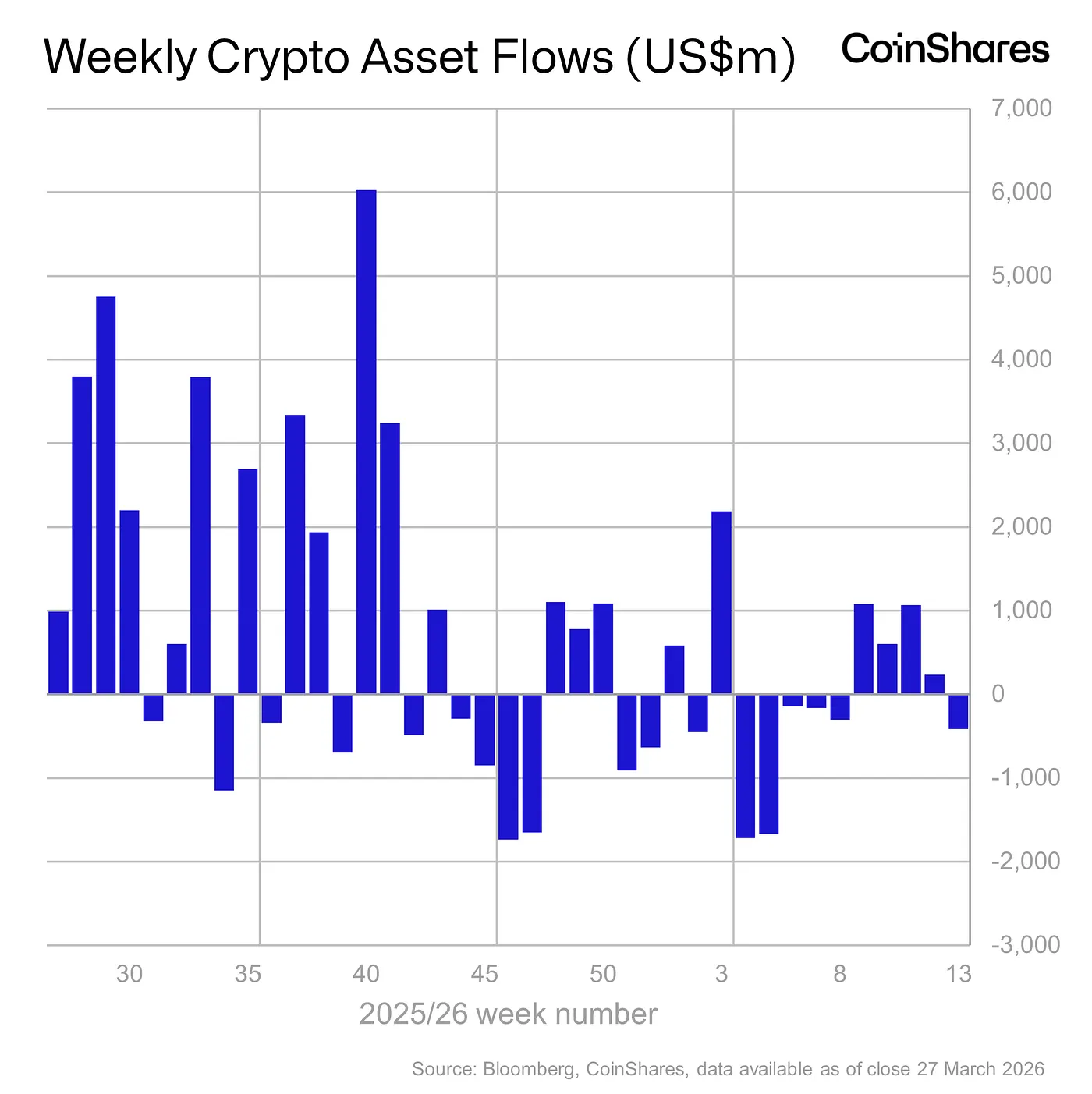
Digital asset investment products saw the first outflows in five weeks, with US$414 million leaving funds. The outflows are due to the impacts of the Iran war, including the expectation that central banks may need to hike rates this year.
In altcoins, Solana saw outflows of US$12.3 million, while XRP saw inflows of US$15.8 million.
CoinShares has filed for a suite of bitcoin volatility ETFs, including base, leveraged and inverse products, designed to track price swings rather than bitcoin’s price. The funds aim to give investors tools to hedge or speculate on market turbulence, reflecting growing institutional demand for more sophisticated crypto derivatives.
Other crypto news
- The latest draft of the CLARITY Act reviewed in closed-door Capitol Hill sessions this week would ban stablecoin yield on balances, delivering a key win for traditional banks that argued such rewards threaten deposits. Circle shares declined by 20% on the news, as investors priced in reduced competitiveness for stablecoin issuers and a shift toward bank-aligned regulation. The Act will go to a Senate Banking Committee markup vote in the second half of April. Polymarket currently puts the odds of the Act becoming law in 2026 at 55%.
- Intercontinental Exchange (ICE), the parent of the New York Stock Exchange, has completed a US$600 million investment in prediction-market platform Polymarket as part of a broader commitment of up to US$2 billion. The move deepens ICE’s push into event-based trading and data, though it is not expected to materially impact financial results.
- Bank of Montreal (BMO) is launching a 24/7 tokenised cash platform with CME Group and Google Cloud, allowing institutional clients to convert dollars into blockchain-based cash for real-time settlement, margin and collateral use. The system aims to improve capital efficiency, reduce friction and support always-on global markets.
- White House crypto adviser David Sacks stepped down after reaching the 130-day limit for special government employees, leaving key legislation unresolved. His departure removes a central figure in negotiations around stablecoin and market-structure bills, though he will continue advising via the President’s Council of Advisors on Science and Technology.
- The Commodity Futures Trading Commission launched an Innovation Task Force to develop clearer rules for crypto, AI and prediction markets, aiming to keep pace with rapid financial innovation. Led by senior adviser Michael Passalacqua, the group will coordinate with the U.S. Securities and Exchange Commission and industry stakeholders to reduce regulatory uncertainty and strengthen U.S. competitiveness.
- The New York Stock Exchange (NYSE) partnered with Securitize to build infrastructure for tokenised securities, enabling stocks, bonds and ETFs to trade on blockchain-based platforms. The initiative includes developing standards and a digital transfer-agent framework, signaling deeper integration between Wall Street and crypto as traditional assets move on-chain.
- Coinbase partnered with Fannie Mae-approved lender Better to enable crypto-backed mortgages, allowing homebuyers to pledge bitcoin or USDC as collateral for down payments instead of selling assets. The structure uses a dual-loan model, helping borrowers retain crypto exposure and defer taxes, marking a step toward integrating digital assets into mainstream housing finance.
- Tether hired KPMG to conduct its first full audit of USDT reserves, moving beyond periodic attestations to a comprehensive review of assets, liabilities and internal controls. The effort, supported by PwC preparing internal systems, comes as the stablecoin issuer pushes into the U.S. and seeks to strengthen transparency amid regulatory scrutiny. Also this week, Tether has expanded its gold-backed token XAUT to BNB Chain, broadening access to the roughly US$2.5 billion product.
- Delaware lawmakers proposed a state-level licensing framework for stablecoin issuers, aiming to attract digital-asset firms while strengthening oversight. The regime would set requirements around reserves, compliance and operations, positioning Delaware as a competitive jurisdiction for crypto businesses amid growing U.S. regulatory fragmentation and ongoing federal policy uncertainty.
- The Reserve Bank of Australia is laying the groundwork for tokenised asset markets following its Project Acacia research, shifting focus from experimentation to implementation. Regulators are coordinating on legal frameworks, infrastructure and potential sandboxes to support adoption, with tokenised bonds, stablecoins and bank deposit tokens seen as key early use cases.
from Caleb & Brown Cryptocurrency Brokerage.


