


Market highlights
- Iran is reportedly accepting bitcoin payments for passage through the Strait of Hormuz.
- Tom Lee’s Ethereum treasury firm BitMine was uplisted to the New York Stock Exchange.
- Proposed Ethereum standard, ERC-8211, would let AI agents execute DeFi strategies.
- Morgan Stanley’s bitcoin ETF drew in US$31 million on its first trading day.
- U.S. Treasury Secretary Bessent criticised crypto leaders opposing the CLARITY Act.
- U.S. Treasury proposed stablecoin AML/KYC rules under the GENIUS Act.
Macro market overview
Risk assets saw a bid this week following the two-week ceasefire in the Iran war agreed on April 7. The S&P 500, Nasdaq and Dow Jones each saw their strongest performance in months, while the trading week ended with stocks reaching five-week highs. In the days following the April 7 agreement, Israel launched attacks on Lebanon and Iran continued to keep the Strait of Hormuz closed, contravening the agreement and necessitating further negotiations. U.S. stock futures declined over the weekend as a result. On Monday, April 13, the U.S. announced it will try a blockade in the Strait of Hormuz, which would stop freight moving in and out of the channel.
In economic data, the U.S. core consumer price index (CPI) came in just below forecast at 3.3% for the 12 months ending March 31, 2026, which presumably contributed to this week’s recovery in sentiment. The on-target CPI reading hasn’t changed expectations for the U.S. Federal Open Market Committee’s (FOMC) rate decision at its April 29 meeting. CME’s Fed Watch tool puts the likelihood of rates remaining on hold at 99%.
Heading into the new week, market participants will presumably be monitoring the U.S. producer price index (PPI) update on Tuesday, April 14, while further developments in the Iran war will likely move markets.
Weekly performance: S&P 500 +3.5%, Dow Jones +3.1%, Nasdaq +5.6%.
Looking ahead:
- U.S. PPI - Tuesday, April 14
Crypto Market Performance
Market Cap: $2.51T (+4.3%)
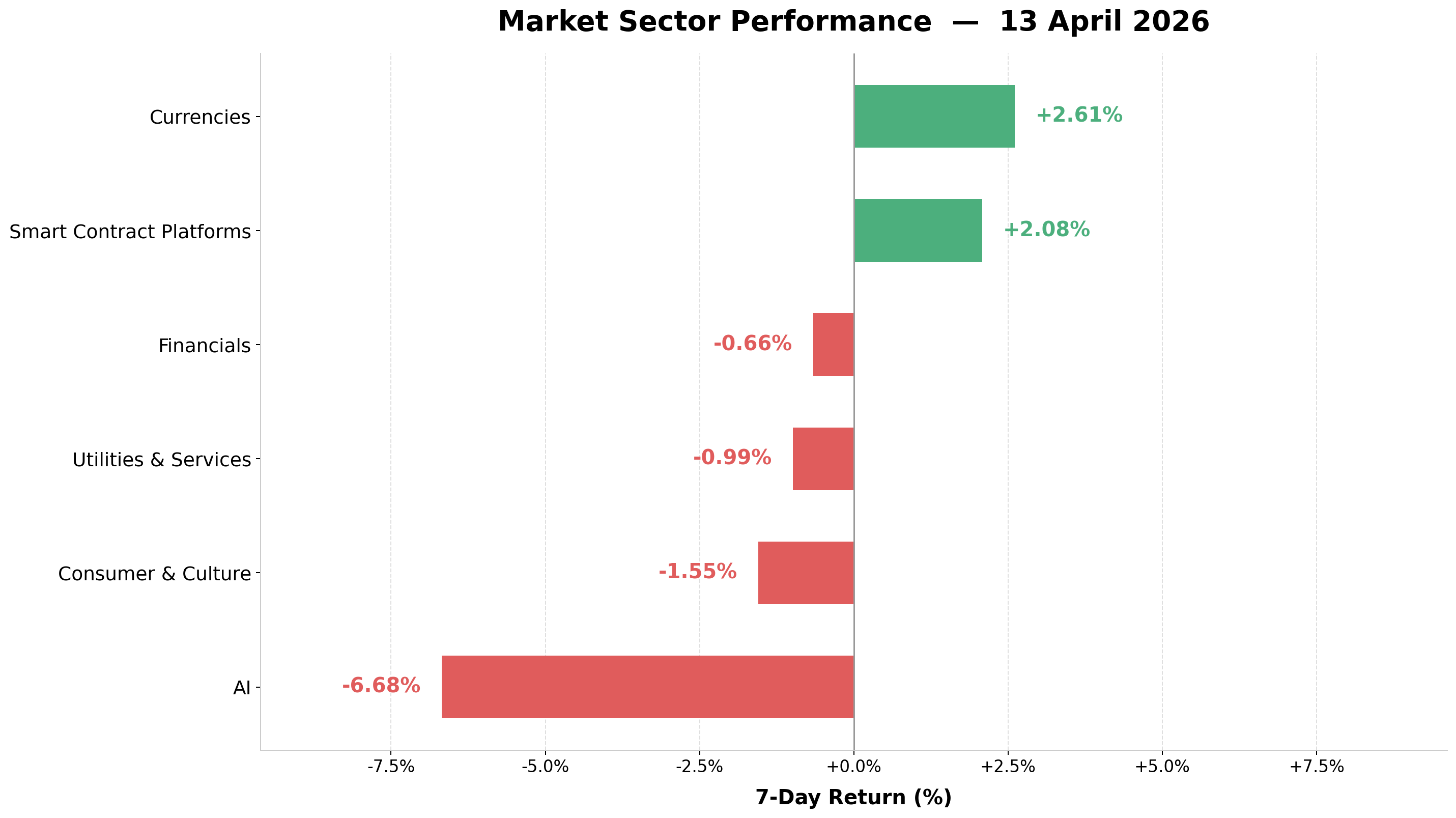
Sector performance was mixed this week, with some sectors seeing minor losses, while smart contract platforms and currencies saw small gains. The relatively flat performance is to be expected given many cryptocurrencies returned bullish momentum from earlier in the week on further uncertainty over the Iran war throughout the weekend. The crypto fear and greed index is currently neutral at 53.
Bitcoin (BTC)
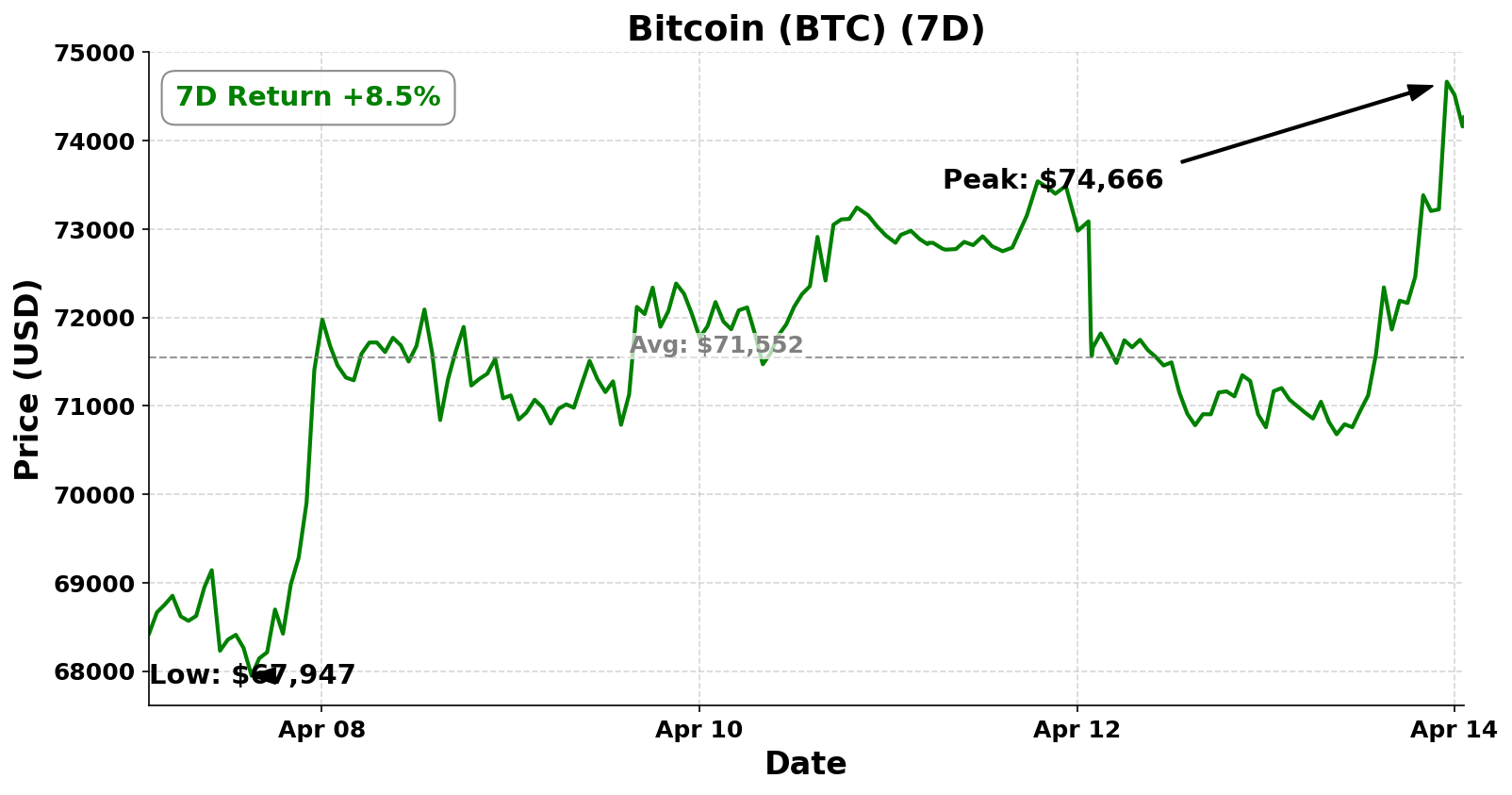
- Opened the week at US$69,005 and rallied to a weekly high of US$72,997 on Saturday, April 11. Risk-off sentiment returning due to uncertainty over the Iran war saw a sell-off into the new week before bitcoin rallied throughout Monday, April 13. Bitcoin is now trading around US$74,265 (+7.1% 7D).
- BTC dominance ranged between 59% and 59.7% this week.
- Bitcoin investment products saw inflows of US$871 million.
Iran is reportedly requiring oil tankers to pay transit tolls, typically around US$1 per barrel, in bitcoin or stablecoins to pass through the Strait of Hormuz throughout the ceasefire. The system, linked to the Islamic Revolutionary Guard Corps (IRGC), is leveraging crypto to evade sanctions, but exposes shipping firms to significant legal and compliance risks.
A bitcoin whale transferred 300 BTC (around US$20 million) to Binance, signalling a potential sale amid broader market weakness. The wallet likely faces a US$15 million loss based on prior purchase prices. The move reflects ongoing sell pressure from large holders, with analysts warning continued distribution could weigh on bitcoin’s price.
Adam Back denied claims he is Satoshi Nakamoto after a The New York Times investigation suggested otherwise. The report cited linguistic and behavioural similarities, but Back dismissed the evidence as coincidence and confirmation bias, maintaining the mystery of bitcoin’s creator remains unresolved.
In bitcoin buying news:
- Strategy bought 13, 927 BTC (US$1B), bringing its total holdings to 780,897 BTC at an average purchase price of US$75,577 per bitcoin.
Ethereum (ETH)
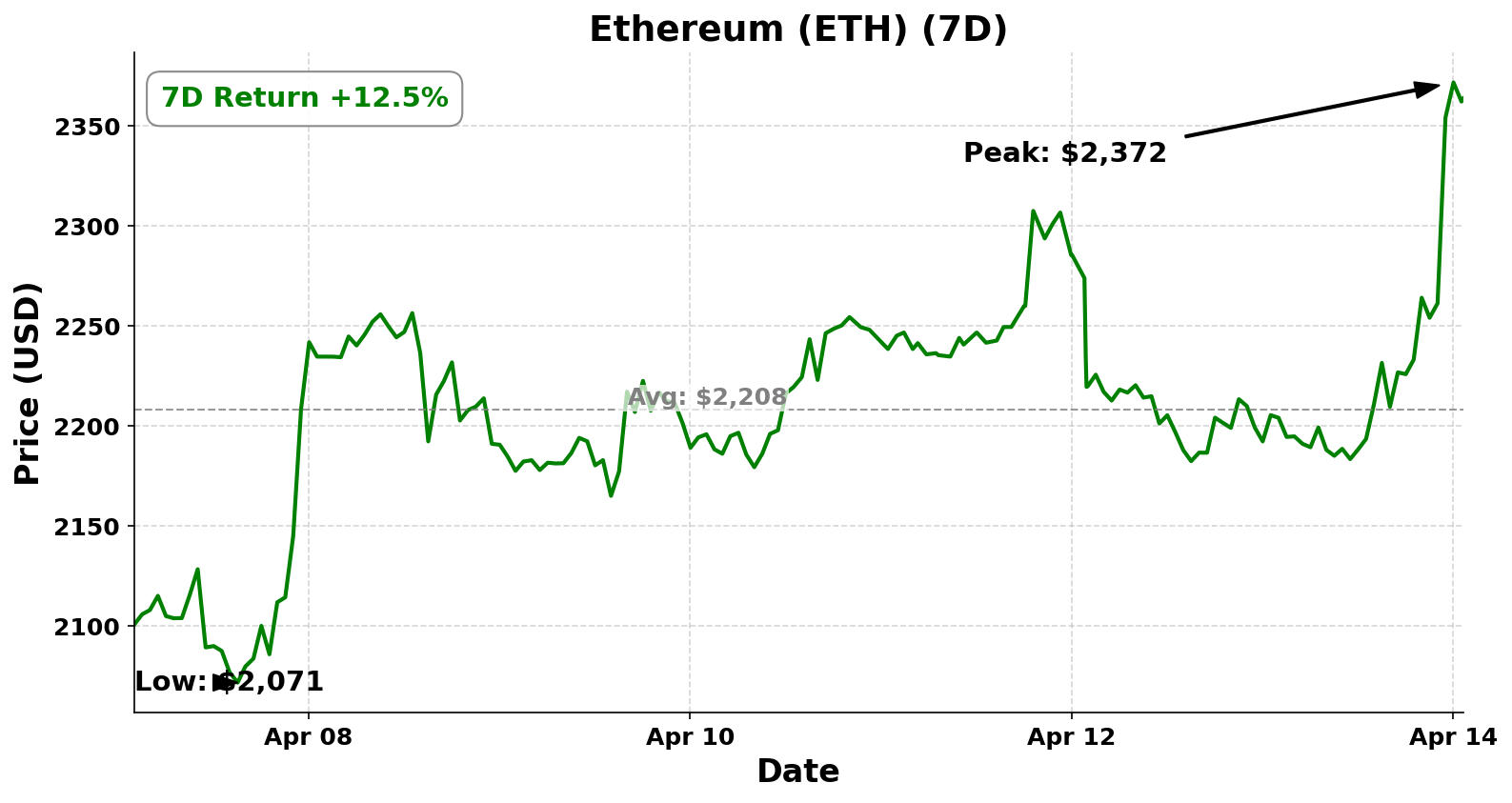
- Opened the week at US$2,109 and saw upward momentum to a weekly high of US$2,330 as on-forecast U.S. CPI data and the original agreement to a ceasefire in the Iran war buoyed sentiment. Ethereum saw further strength into the new week and is now trading around US$2,340 (+10% 7D).
- Ethereum dominance ranged between 10.8% and 11.3% this week.
- Ethereum-focused funds saw inflows of US$196.5 million.
Tom Lee’s Ethereum treasury firm BitMine was uplisted to the New York Stock Exchange, boosting visibility with institutional investors. The company also expanded its share buyback program to US$4 billion from US$1 billion, aiming to repurchase stock when it trades below intrinsic value, while continuing to accumulate large ETH holdings.
A proposed Ethereum standard, ERC-8211, would let artificial intelligence (AI) agents execute complex DeFi strategies by bundling multi-step transactions into a single “smart batch.” It dynamically resolves each step at execution, improving efficiency and UX without protocol changes, while enabling more advanced automated trading.
In Ethereum buying news:
- BitMine bought 71,524 ETH this week. This brings the company’s holdings to almost 4.9 million ETH, worth US$10.7 billion. The company is also earning US$212 million in annualised revenue from staking.
Altcoins
The altcoin season index is currently 32, which is bitcoin season.
Believe the HYPE
- Hyperliquid gained 20%. Traders on the platform faced widespread liquidations on whipsawing oil prices. About US$79.7 million in leveraged oil positions were wiped out. The event highlights growing exposure to real-world assets on-chain, where sudden macro moves can trigger rapid losses across highly leveraged positions.
World Liberty Financial (aid)
- World Liberty Financial (WLFI), the Trump-linked DeFi project declined by 18.6%. The declines came on the team asking DeFi protocol, Dolomite, for a US$160 million USDC loan and a proposal to unlock tokens for early holders. Also this week, it was revealed that AB network, a company that partnered with WLFI, has links to Cambodian scam operation, Prince Group, which involved three individuals who were sanctioned by the U.S. Treasury.
Ecosystem exits
- Bittensor declined by 16.6%. The token for the decentralised AI marketplace plunged by over 18% on the news that major ecosystem developer, Covenant AI, announced its departure, citing concerns over centralised control by the network’s founder. The dispute sparked market volatility and raised broader questions about Bittensor’s governance model, despite the founder denying the allegations.
- Aave gained 7.2%. The DeFi lending protocol fell to a near two-year low around US$86, dropping over 6% on April 8, after risk management firm Chaos Labs exited the protocol’s decentralised autonomous organisation amid disputes and operational losses. The departure, alongside other exits, has raised concerns about governance stability and risk oversight, though the token has seen a small bounce into the new week.
Solana security on lock
- Solana gained 6.5%. The networks’s foundation moved to support DeFi security after the recent US$285 million exploit on Drift Protocol. The STRIDE Security program will provide 24/7 monitoring for Solana protocols with over US$10 million total value locked. Drift Protocol’s hack stemmed from social engineering and governance failures, not flaws in network coding.
Crypto ETF News
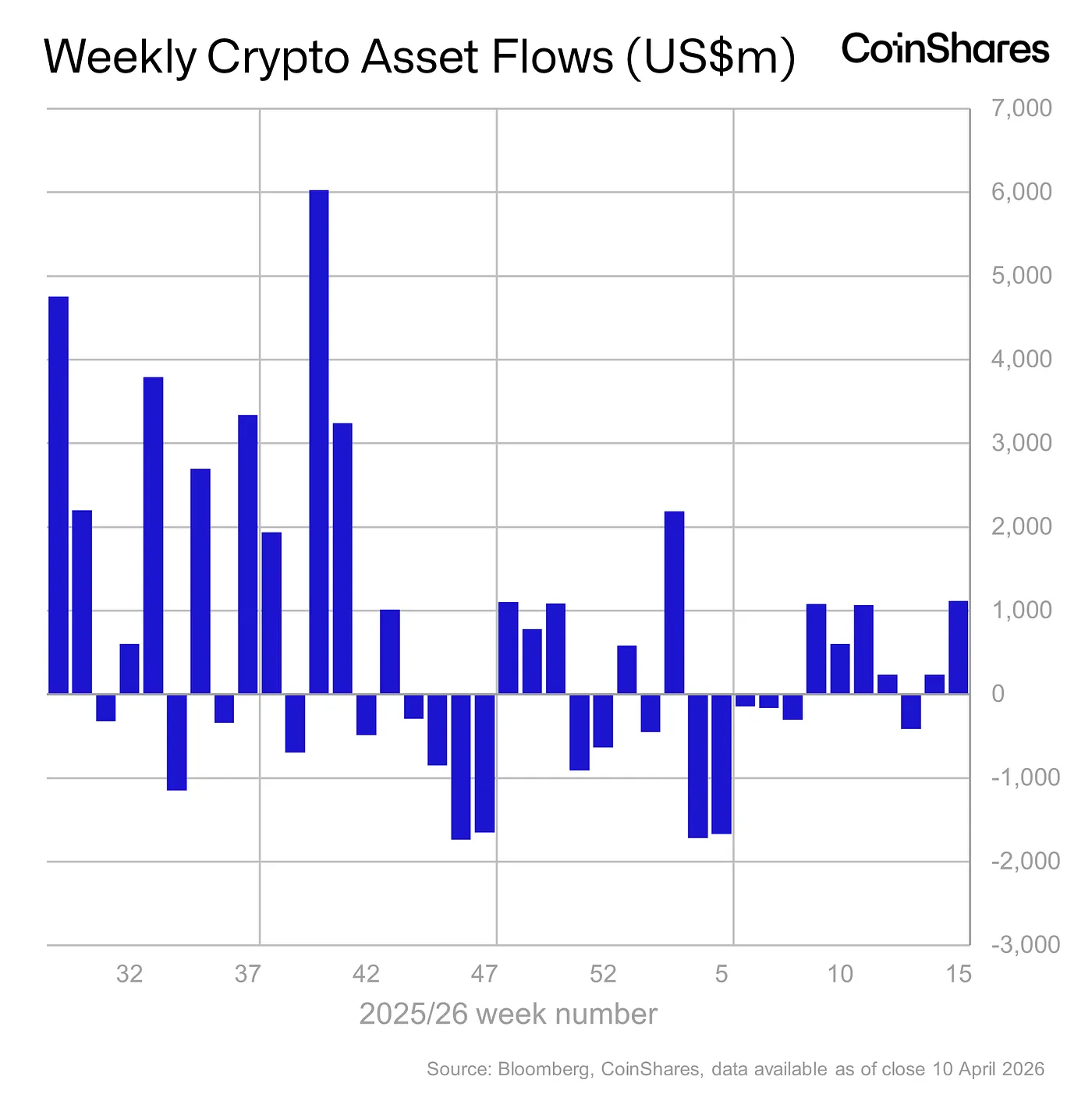
Digital asset investment products saw US$1.1 billion of inflows, in the largest weekly total of inflows since January. The recovery in inflows reflects an improvement in sentiment throughout the fast half of the week after a ceasefire in the Iran war was agreed (though it didn’t hold later).
In altcoins, XRP saw inflows of US$19.3 million, and Solana saw outflows of US$2.5 million.
Morgan Stanley’s bitcoin exchange-traded fund (ETF) drew in US$31 million in its first trading day on Wednesday, April 8. The company’s head of digital asset strategy, Amy Oldenburg, used the launch to outline the firm’s future crypto plans, from tokenisation to tax-efficient investment structures.
Other crypto news
- U.S. Treasury Secretary Scott Bessent criticised crypto leaders opposing the CLARITY Act, calling them “nihilists” for resisting regulation. Disputes over stablecoin yield rules and TradFi influence on regulatory developments continue to slow progress, raising concerns the legislation could miss key deadlines. The Act is due to proceed to a Senate Banking Committee markup vote in the second half of April.
- The U.S. Treasury proposed rules under the GENIUS Act requiring stablecoin issuers to implement anti-money laundering and sanctions compliance programs, effectively treating them as financial institutions. The framework includes transaction monitoring, reporting obligations and the ability to freeze or block illicit activity, aiming to balance security with continued innovation.
- CME Group plans to launch Avalanche and Sui futures, expanding its regulated crypto derivatives suite beyond major tokens. The move reflects rising institutional demand for altcoin exposure, offering both standard and micro contracts. The additional altcoins contracts will begin trading in May ahead of the firm’s move to 24/7 crypto futures trading.
- Hong Kong has granted its first stablecoin licences to HSBC and a Standard Chartered-led joint venture, marking a key step in its digital asset strategy. The regulated, Hong Kong dollar-backed tokens aim to support payments and trading, with authorities taking a cautious, limited-licence approach.
- Crypto wallet provider Exodus launched Exodus Pay, enabling users to spend bitcoin and stablecoins directly from a self-custody wallet at merchants via Visa and Apple Pay. The feature aims to reduce reliance on intermediaries and simplify crypto payments, though it is initially limited to select U.S. states as the company prepares a broader rollout.
from Caleb & Brown Cryptocurrency Brokerage.


