


Market highlights
- Crypto liquidations topped US$400 million on Sunday, March 22 due to risk-off sentiment.
- Hyperliquid now offering officially licensed S&P 500 perpetual futures.
- Nasdaq secured U.S. SEC approval to launch a pilot program for tokenised securities
- Senate CLARITY Act to go to Banking Committee markup vote in April.
- U.S. SEC issued guidance that most crypto assets are not securities.
- U.S. SEC and CFTC classified 16 cryptocurrencies as digital commodities.
Macro market overview
The major U.S. indexes fell to four-month lows this week as the Iran war continues, oil prices remain elevated, and central banks re-assess their monetary policy approaches. As expected, the U.S. Federal Open Market Committee (FOMC) left rates on hold at 3.75% at its March 18 meeting, while the Bank of Canada, Bank of Japan, European Central Bank (ECB), Bank of England (BoE) and Swiss National Bank also left rates on hold. The ongoing conflict in the Middle East and the subsequent economic and market impacts have seen analysts lower their expectations for rate cuts this year, with the BoE and ECB even expected to begin hiking rates.
Bond yields globally moved higher this week. The U.S. 10-year treasury yield reached almost 4.4%, while the two-year treasury yield gained 6.1 basis points to 3.9%, demonstrating that bond markets are pricing in potential U.S. rate hikes this year. Oil is currently trading around US$89.30 per barrel. Gold and silver declined this week, selling off by 10.3% and 15%, respectively.
Looking to the week ahead, market participants will presumably be monitoring commentary around oil prices and flash manufacturing and services purchasing manager indexes (PMI) updates from the the U.S., U.K., and Germany. President Trump also announced a five-day postponement on further strikes on Iran, which could buoy risk assets.
Weekly performance: S&P 500 -2.6%, Dow Jones -2.4%, Nasdaq -1.8%.
Looking ahead:
- Germany; U.K. flash manufacturing and services PMI - Tuesday, March 24
- U.S. flash manufacturing and services PMI - Wednesday, March 25
Crypto Market Performance
Market Cap: $2.42T (+3%)
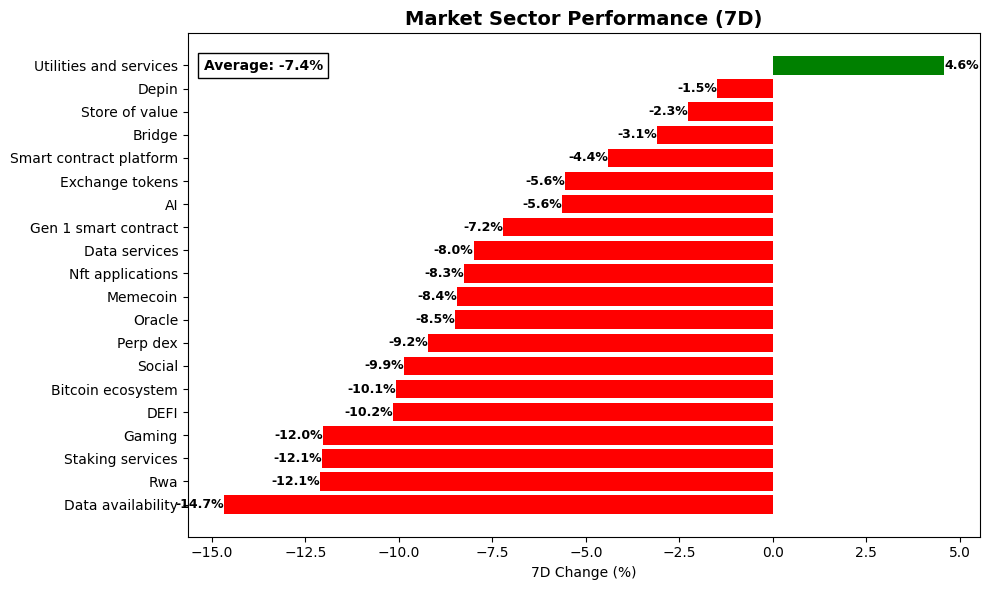
Most crypto sectors saw declines this week as risk-off sentiment prevailed across TradFi and crypto. And as crypto declines from the October 2025 highs, so has trading volume. Altcoin volume has dropped 80% from around US$40 billion to US$7.7 billion throughout the last four months due to tighter monetary policy conditions and persistent global-macro uncertainty. Liquidations topped US$400 million on Sunday, March 22 as weakness persisted across crypto. The crypto fear and greed index is currently in fear territory at 32.
Biggest gainer:
- Utilities and services: DeXe (DEXE) (+45.1%) gained as the network’s protocol, which specialises in creating decentralised autonomous organisations (DAOs) builds traction. The gains came due to broader macro developments in DAOs, inlcuding increased institutional adoption of DAO structures and the migration of traditional corporate structures onto blockchain rails.
Bitcoin (BTC)
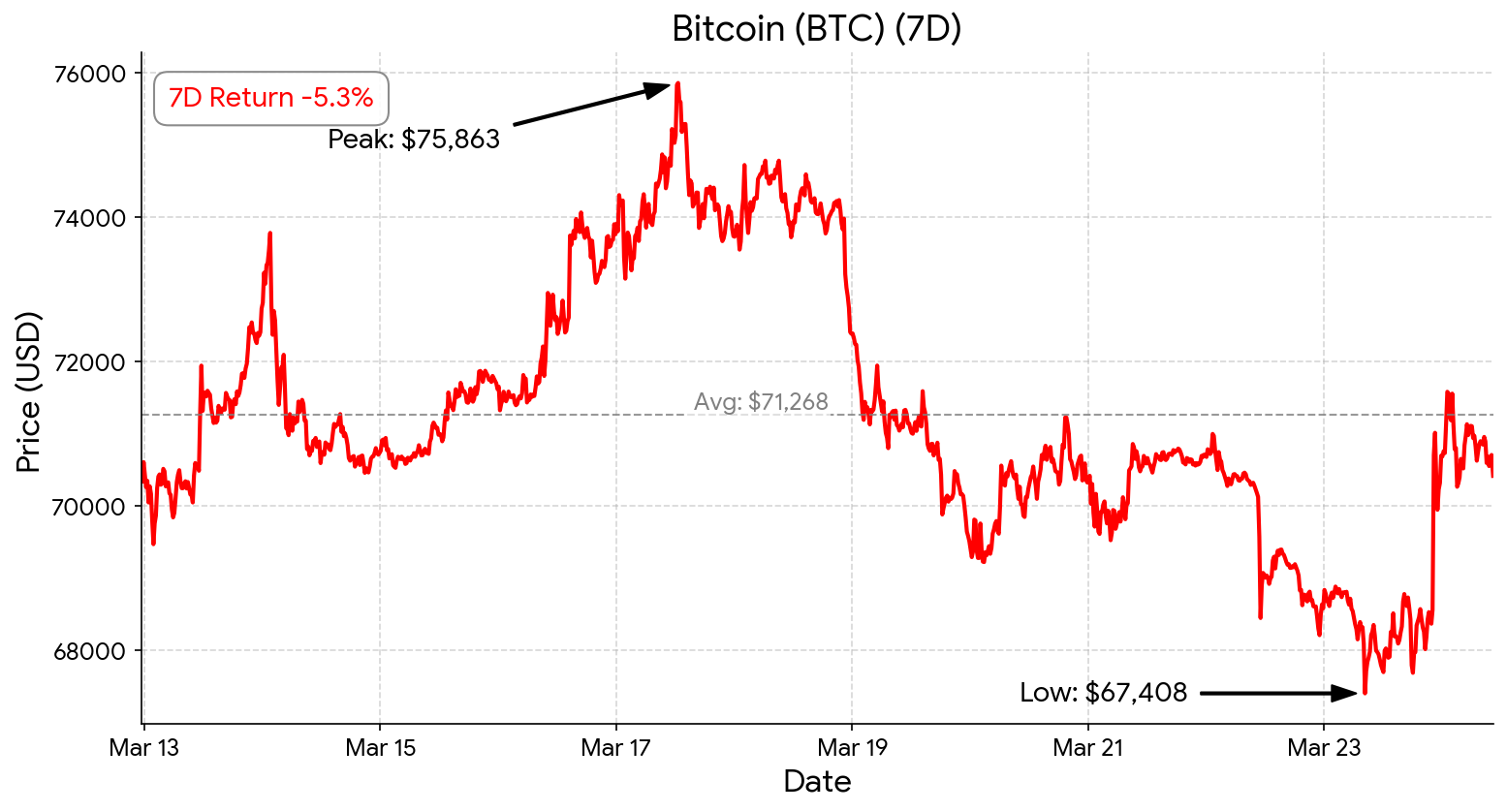
- Opened the week at US$72,830, and declined to a low of US$67,332 on Sunday, March 22 on continued macroeconomic and geopolitical uncertainty, particularly around the Iran war and subsequent inflationary impact of high oil prices. Bitcoin is now trading around US$70,600, as crypto sees strength on the postponement of drone strikes on Iranian power plants for five days (-5.7% 7D).
- BTC dominance ranged between 58.8% and 59.4% this week.
- Bitcoin investment products saw inflows of US$219 million.
The recent divergence between bitcoin and gold, despite BTC being called “digital gold”, reflects a split in demand and price drivers. Analysts say central bank policy and currency debasement have driven gold’s rally. Gold has also benefited from recent geopolitical tensions, while bitcoin has served as a 24/7 alternative during financial disruptions or when market shocks occur outside TradFi trading hours.
In bitcoin buying news:
- Strategy bought 1,031 BTC (US$77M), bringing its total holdings to 762,099 BTC at an average purchase price of US$75,694 per bitcoin.
- European bitcoin treasury firm H100 plans to triple its BTC holdings by acquiring Moonshot AS and Never Say Die AS in an all-stock transaction, which would bring the company’s BTC holdings to 3,500.
Ethereum (ETH)
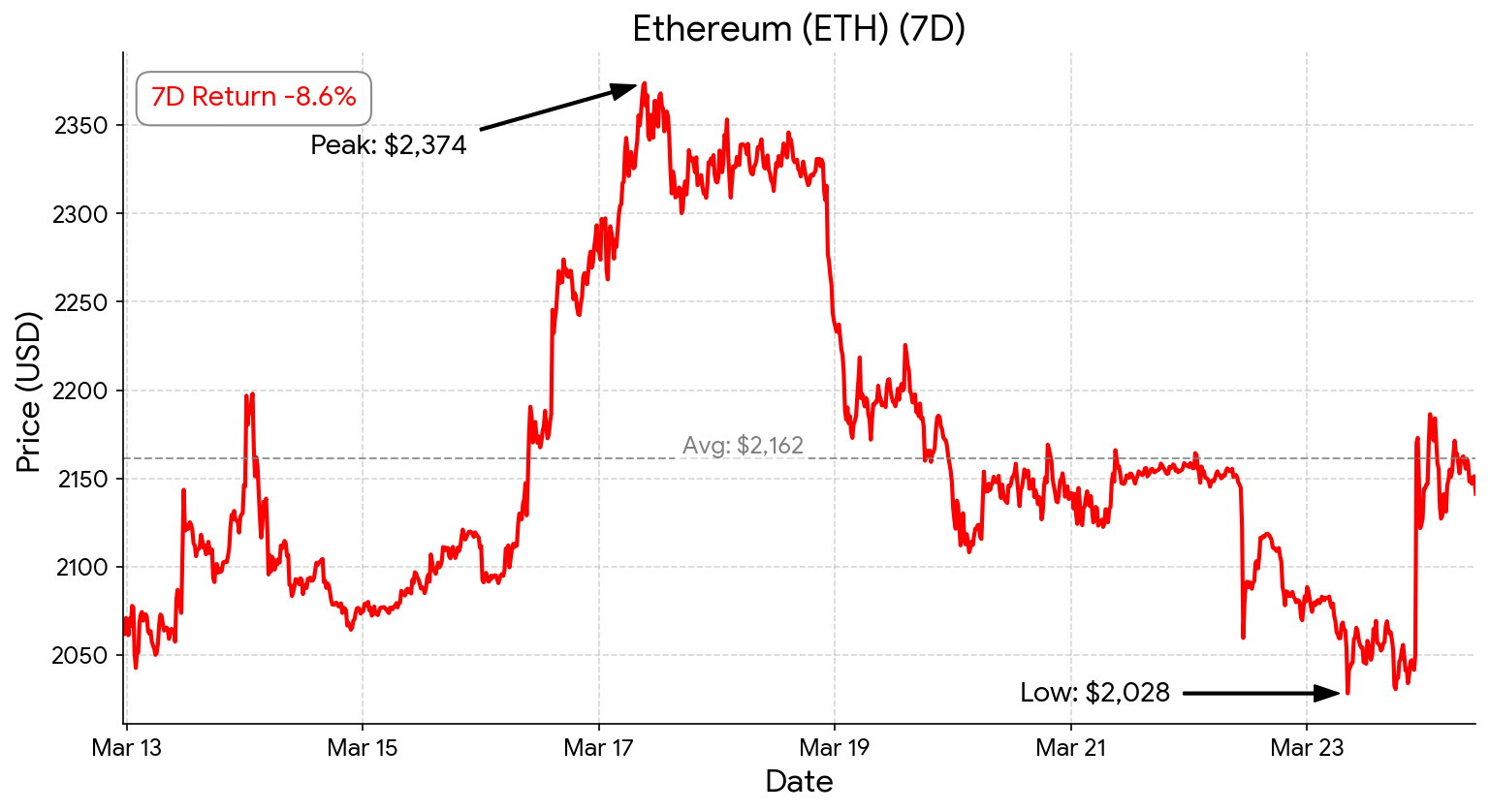
- Opened the week at US$2,178 and declined to a low of US$2,025 on Sunday, March 23 on persistent global-macro uncertainty. Ethereum is now trading around US$2,150, as ETH made a 5% macro-driven gain to start the new week (-9.4% 7D).
- Ethereum dominance ranged between 10.6% and 10.7% this week.
- Ethereum-focused funds saw outflows of US$27.5 million.
Ethereum’s network activity surged this week, with active addresses jumping about 121% from roughly 381,000 to over 840,000. The spike signals renewed user engagement across DeFi and non-fungible tokens (NFTs), coinciding with the rally toward $2,400 earlier in the week.
In Ethereum buying news:
- BitMine bought 65,341 Ethereum, bringing the company’s holdings to almost 4.7 million ETH worth US$11 billion.
Altcoins
The altcoin season index is currently 45, which is bitcoin season.
DeFi declines
- Ethena declined by 21.9%. The synthetic dollar protocol built on Ethereum saw losses presumably due to broader weak sentiment despite the announcement of a new integration with crypto wallet infrastructure provider, Privy. The integration allows users to access Ethena-based savings across Privy’s products.
- Hyperliquid declined by 7.8%. The decentralised exchange is now offering officially licensed S&P 500 perpetual futures, enabling traders to speculate on the index 24/7 with leverage via blockchain markets.
- XRP declined by 7%, though it did rise to its highest price in a month earlier in the week. The gains came as Ripple, the company that created XRP, expanded its Brazil strategy. The firm plans to seek a local license and roll out payments, custody and brokerage services, with rising derivatives activity signalling renewed investor interest.
Crypto ETF News
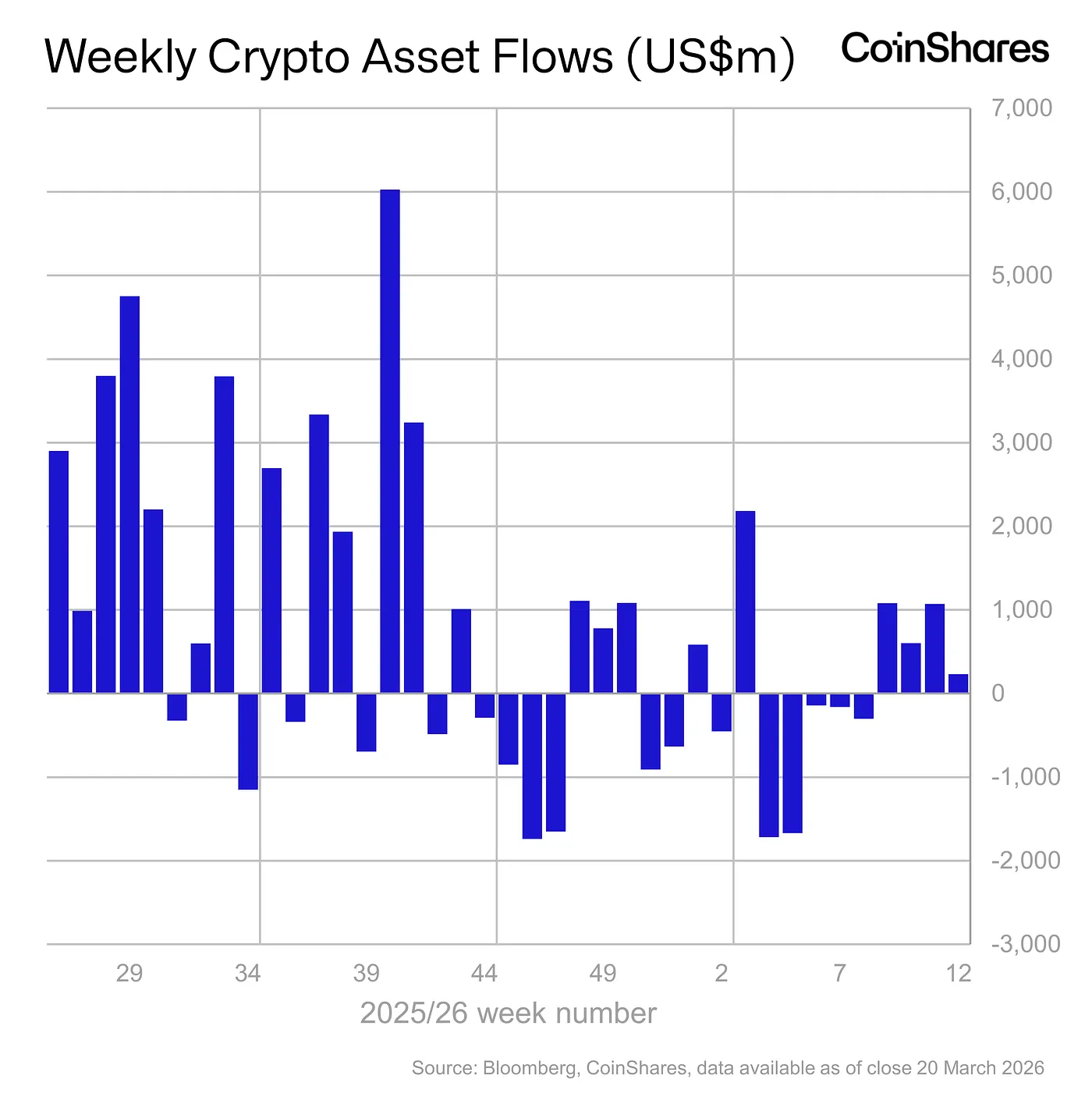
Digital asset investment product inflows slowed this week to US$230 million as the U.S. Federal Reserve’s hawkish stance at its March 18 meeting contributed to risk-off sentiment.
In altcoins, Solana saw inflows of US$17 million, while Chainlink and Hyperliquid saw inflows of US$4.6 million and US$4.5 million, respectively.
BlackRock’s iShares Staked Ethereum Trust reached US$254 million of assets under management in its first week of trading. The fund stakes 70% to 95% of its ETH, and 82% of staking rewards are distributed to investors via monthly payments.
Morgan Stanley has updated its spot bitcoin exchange-traded fund (ETF) filing, confirming the MSBT ticker on NYSE Arca and adding custodians including Fidelity. The Morgan Stanley Bitcoin Trust will waive fees for the first US$5 billion invested for six months.
Other crypto news
- The Senate’s crypto market structure bill, the CLARITY Act is set for a key Senate Banking Committee vote in April, with lawmakers warning it must pass by May or broader crypto legislation could stall ahead of midterm elections. Ongoing disputes over stablecoin yields, DeFi rules and ethics provisions continue to threaten bipartisan support and final passage.
- The U.S. Securities and Exchange Commission (SEC) issued guidance that states most crypto assets are not securities, including activities like staking, airdrops and bitcoin mining, marking a major policy shift. The agency, in partnership with the Commodity Futures Trading Commission (CFTC) also classified 16 cryptocurrencies as digital commodities, including Aptos (APT), Avalanche (AVAX), bitcoin (BTC), bitcoin cash (BCH), Cardano (ADA), Chainlink (LINK), Dogecoin (DOGE), Ethereum (ETH), Hedera (HBAR), Litecoin (LTC), Polkadot (DOT), Shiba Inu (SHIB), Solana (SOL), Stellar (XLM), Texos (XTZ), and XRP (XRP).
- Nasdaq secured U.S. SEC approval to launch a pilot program for tokenised securities, allowing select stocks and ETFs to trade in blockchain-based form alongside traditional shares. The tokens will carry identical rights and settle through existing infrastructure, marking a cautious step toward integrating tokenisation into regulated equity markets.
- Mastercard has agreed to acquire stablecoin infrastructure firm BVNK to connect on-chain payments with traditional fiat rails, enabling faster cross-border transactions and digital asset settlement. The deal reflects Mastercard’s push to integrate blockchain into its network, giving businesses the ability to send, receive and convert stablecoins alongside existing payment systems.
- Tokenisation platform Theo raised US$100 million to launch a yield-bearing stablecoin backed by gold, combining exposure to spot prices with returns from gold futures strategies and DeFi lending. The model aims to offer both stability and income, addressing limitations of existing gold-backed tokens that typically lack native yield.
- Solana treasury firm Forward Industries said it repurchased over 6 million shares for US$27.4 million, funded by a US$40 million crypto-backed loan secured by its SOL holdings. The move aims to boost SOL-per-share value after an 89% stock decline, with buybacks favoured over token purchases when shares trade below net asset value.
- Evernorth Holdings has filed with the U.S. SEC to go public via a SPAC merger, aiming to launch with about US$685 million in XRP holdings and become the largest listed XRP treasury firm. Crypto wealth manager Abra also plans to go public via a US$750 million SPAC merger with New Providence Acquisition Corp. III, listing on Nasdaq under ABRX. The firm is targeting US$10 billion in assets under management by 2027.
from Caleb & Brown Cryptocurrency Brokerage.


