


Market highlights
- Crypto sold off on the FOMC’s hawkish stance following its December 10 rate cut.
- XRP is expanding to Ethereum and Solana through wrapping and bridging mechanisms.
- The U.S. OCC granted conditional national trust bank charters to five digital-asset firms.
- The U.S. SEC approved a pilot allowing select securities to be recored on blockchains.
- Do Kwon received a 15-year prison sentence due to US$40billion Terra ecosystem collapse.
Markets Overview
Performance across risk assets was mixed this week, as market participants rotated out of technology stocks into other segments of the market that are more reasonably priced. As a result, the Dow Jones closed at a new all-time high, while the S&P 500 and Nasdaq retreated. The mixed performance came as the U.S. Federal Open Market Committee (FOMC) delivered a much anticipated 25-basis-point rate cut at its December 10 meeting. The federal funds rate is now 3.5% to 3.75%.
Despite the rate cut, the FOMC remains divided over its monetary policy outlook, with three “no” votes from governors concerned about inflation, representing a hawkish stance. In the FOMC’s statement, similar language to its December 2024 meeting signalled a potential slow down in rate cuts over the coming months. The Fed’s dot plot currently sets expectations for one rate cut in 2026 and another in 2027. Also this week, the Reserve Bank of Australia, Bank of Canada and Swiss National Bank left rates on hold.
Heading into the new week, market participants will presumably be watching for the non-farm payroll update, core retail sales, and the latest consumer price index (CPI) reading. And on Friday, December 19, the Bank of Japan is expected to raise its policy rate by 25 basis points, which could see risk assets sell off further.
Weekly performance: S&P 500 -0.6%, Dow Jones +1%, Nasdaq -2%.
Looking ahead:
- U.S. core retail sales - Tuesday, December 16
- U.S. non-farm employment change - Tuesday, December 16
- U.S. CPI - Thursday, December 18
- Bank of Japan policy rate decision - Friday, December 19
Crypto Market Sector Performance
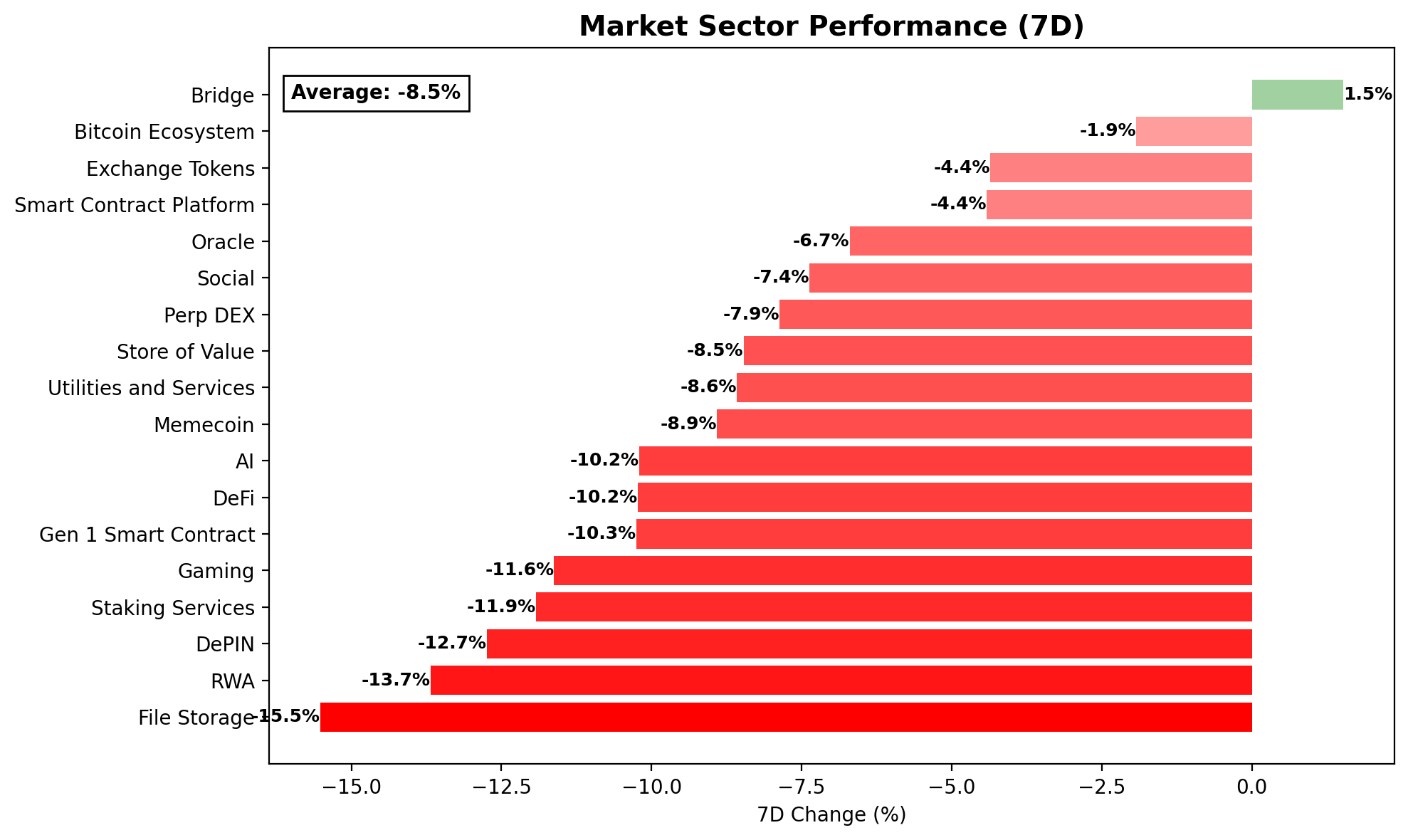
Most crypto sectors saw losses this week, with the exception of bridging, which made minor gains. The declines come as the FOMC’s hawkish stance following its December 10 meeting caused risk assets to sell off throughout the week. Weakness continued into the new week, with total crypto liquidations throughout Monday, December 15 coming to US$573 million. The crypto fear and greed index remains in fear territory at 24.
Bitcoin (BTC)
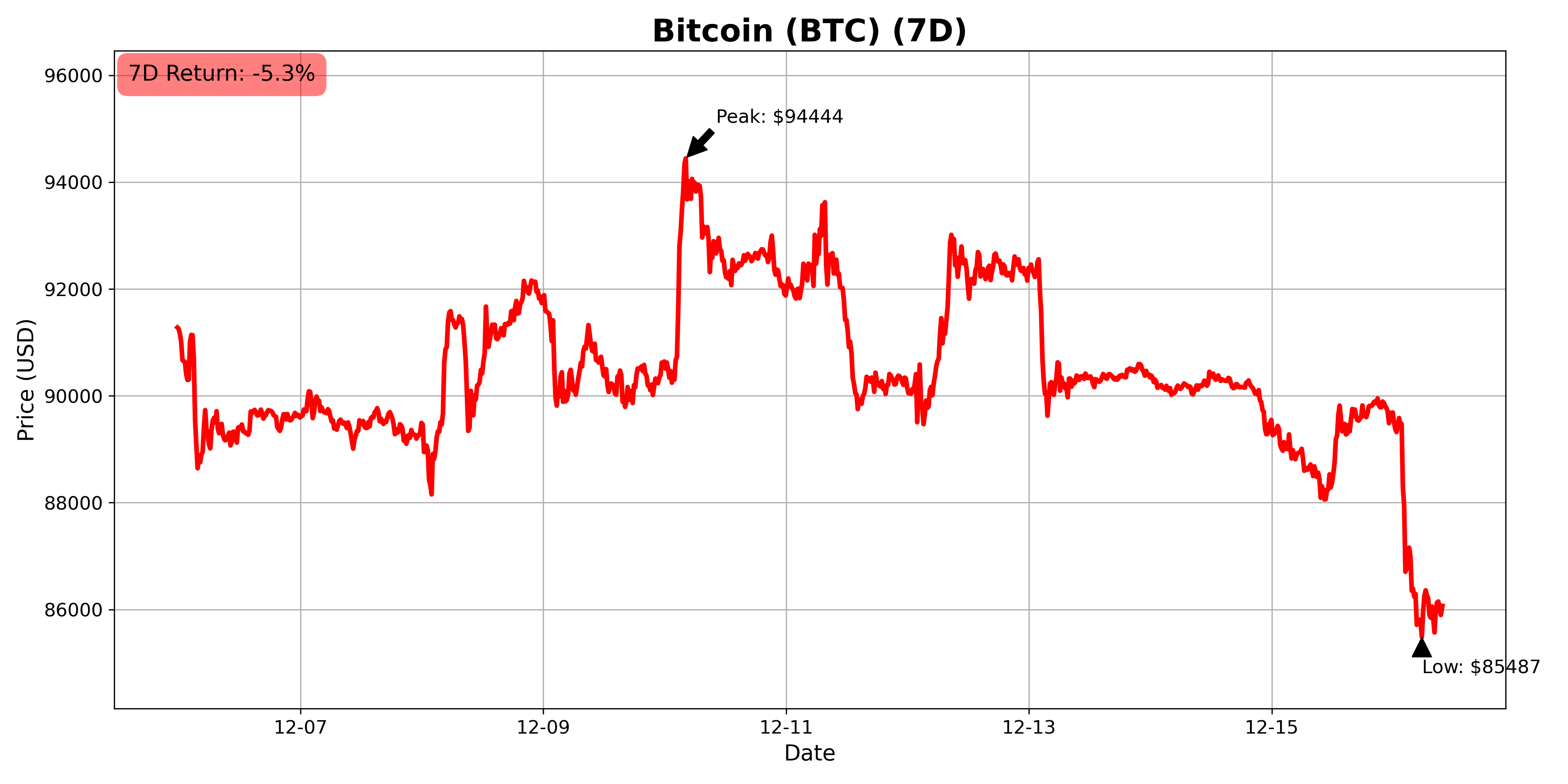
- Opened the week at US$90,402, rallied to a high of US$94,640 on Tuesday, December 9 and then sold off following the FOMC’s hawkish stance following its December 10 meeting. Bitcoin continued to decline as the new week started, selling off to around US$86,000 (-5.5% 7D).
- BTC dominance ranged between 59% and 59.4% this week.
- Bitcoin investment products saw US$522 million of inflows this week. Short bitcoin saw outflows of US$1.8 million.
Despite a subdued week for bitcoin, long-term holders are still buying. According to on-chain data, “accumulator whales” bought 75,000 BTC from December 1 to December 10, while short-term holder losses grow. An “accumulator whale” is a whale that has never sold their BTC, purchases large amounts, and does not have wallets linked to exchanges, miners or smart contracts. Some experts expect a “low-liquidity run-up” into the holidays.
Elon Musk’s SpaceX reportedly moved US$94 million worth of bitcoin on Wednesday, December 10. This marks almost two months of the company moving around US$100 million worth of BTC each week, though there are no signals the firm will sell its holdings. In other bitcoin moves, wallets linked to Silk Road creator Ross Ulbricht moved US$3 million of BTC on Tuesday, December 9 to a fresh wallet address.
In bitcoin buying news:
- Strategy bought 10,645 BTC, bringing the company’s total holdings to 671,268 BTC, with an average purchase price of US$74,972. Strategy continues its year-long stint in the Nasdaq 100, despite some commentators saying the company more closely resembles an investment fund.
Ethereum (ETH)
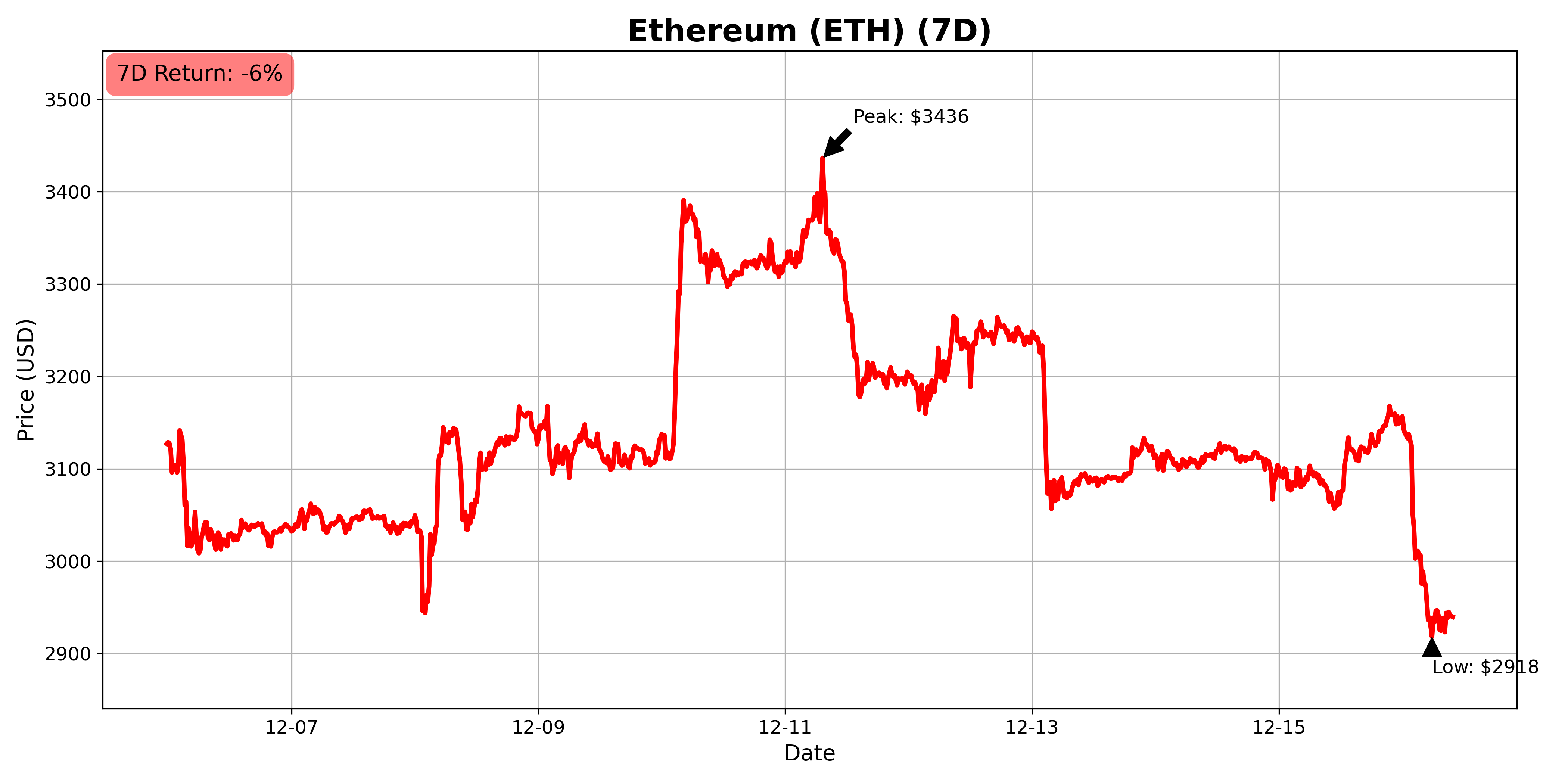
- Opened the week at US$3,060, rallied to a weekly high of US$3,477 on Wednesday, December 10, and retreated to the key level at US$3,045 to end the week. The sell-off was presumably due to the Fed’s hawkish monetary policy outlook. Ethereum continued to decline into the new week, currently trading around US$2,940 (-6.2% 7D).
- Ethereum dominance hovered between 12.2% and 13% this week.
- Ethereum-focused funds saw inflows of US$338 million this week.
Synthetix Network is set to launch its perpetual decentralised exchange on the Ethereum mainnet on December 17. The platform will enable trading of perpetual contracts with on-chain settlement and synthetic assets, aiming to expand DeFi derivatives offerings while leveraging Ethereum’s security and liquidity infrastructure.
In Ethereum buying news:
- BitMine added 102,259 ETH to its treasury, bringing its holdings to over 3.9 million ETH, worth US$12.4 billion.
Altcoins
The altcoin season index rose slightly this week from 35 to 41, which is still bitcoin season.
Staking upgrade
- Mantle gained 16.8%. The gains are presumably due to an upgrade to Buffer Pool’s liquid staking mechanism. The pool is designed for on-demand institutional liquidity, enabling 24-hour redemptions using its dual-liquidity pathway. In the network’s announcement, the team said its mETH Protocol is one of the largest liquid staking tokens, securing networks such as EidenDA and Symbiotic.
Tell me a story
- Story declined by 20.7%. The network, which tokenises intellectual property, has seen a decline of 46% in the last month as altcoins experience continued weakness.
Failure to launch
- Ethena declined by 20.5%. The synthetic dollar protocol built on the Ethereum network presumably saw losses due to two recent token unlocks, which released a further 1.8% of supply, and the cancellation of Terminal Finance’s decentralised exchange launch, which was incubated by Ethena Labs.
Network expansion
- XRP declined 9.4% due to broader market weakness, though the network announced some significant developments this week. The Ripple-linked crypto is expanding to Ethereum and Solana through wrapping and bridging mechanisms, and Ripple’s stablecoin, RLUSD, is expanding to layer-2 Ethereum networks.
Crypto ETF News
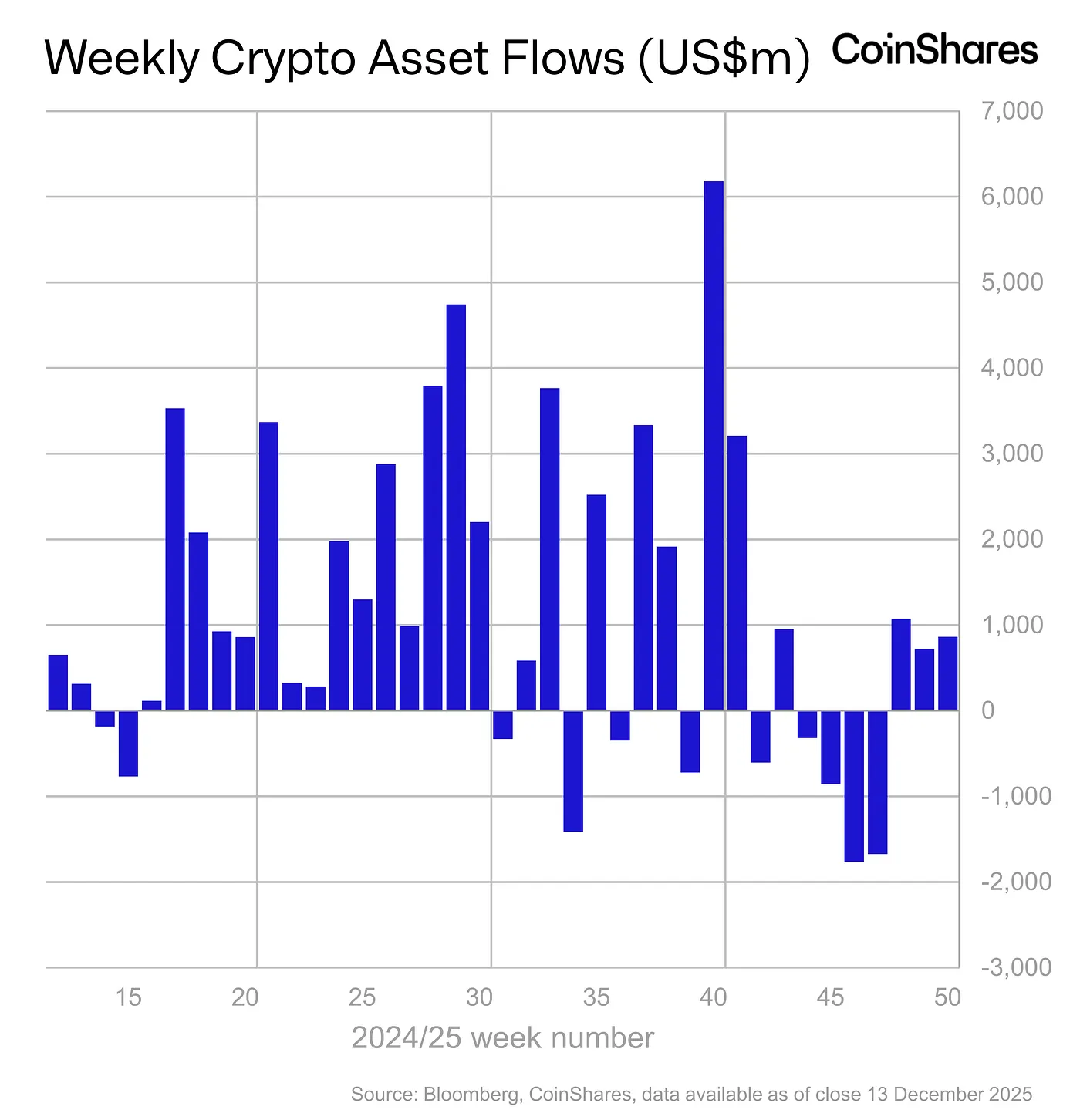
Digital asset investment products saw inflows of US$864 million this week, as sentiment gradually improves despite the continual sell-off across the crypto market.
Some altcoins saw impressive inflows. Solana saw inflows of US$65 million, while Aave and Chainlink saw inflows of US$5.9 million and US$4.1 million, respectively. Hyperliquid saw outflows of US$14.1 million.
Tidal Trust II filed an application with the U.S. Securities and Exchange Commission (SEC) to launch the Nicholas Bitcoin and Treasuries AfterDark exchange-traded fund (ETF). The ETF would hold U.S. treasuries during the day and mirror bitcoin’s overnight returns.
JPMorgan Chase launched its My OnChain Net Yield (MONY) Fund on the Ethereum network. The fund, which is open to qualified investors, will be capitalised with US$100 million of the bank’s funds. The MONY Fund is a money market fund similar to BlackRock’s “BUIDL” fund.
Other crypto news
- The U.S. Office of the Comptroller of the Currency (OCC) granted conditional national trust bank charters to five digital-asset firms: Circle, Ripple, Paxos, Fidelity Digital Assets and BitGo. These approvals, subject to risk and compliance conditions, allow the companies to operate under federal banking supervision for custody and trust services tied to stablecoins and crypto products. It’s important to note that a national trust bank charter does not make these firms “crypto banks,” as they are not authorised to offer the full suite of banking services, such as lending and stablecoin issuance.
- The U.S. SEC approved a pilot allowing the Depository Trust & Clearing Corporation to record select U.S. securities on approved blockchains. The initiative will test blockchain-based record keeping and settlement processes, while maintaining existing investor protections and regulatory oversight within traditional market infrastructure.
- U.S. SEC Chair Paul Atkins stated that many crypto initial coin offerings operate outside the agency’s regulatory authority and should not be considered securities transactions. He highlighted the difficulty of enforcing oversight over decentralised projects, suggesting that significant portions of the crypto market may remain unregulated, stating “that’s what we want to encourage”.
- Tether is reportedly exploring tokenising its equity alongside a potential private share sale that could raise up to US$20 billion at a US$500 billion valuation. The approach would allow shares to trade on blockchain rails, potentially broadening investor access and liquidity. The development follows news that a shareholder was looking to sell US$1 billion of equity at a US$280 billion valuation, potentially damaging the company’s fundraising efforts.
- Klarna has partnered with Stripe and Privy to develop a consumer crypto wallet aimed at mainstream users. The wallet will integrate with existing payments infrastructure and support onboarding, custody and transactions, positioning Klarna to bridge traditional payments with blockchain access and expand everyday crypto use for its large retail customer base. Also this week, Stripe launched its Tempo blockchain payments public testnet, allowing users to start building on the network.
- UK lawmakers have criticised the Bank of England’s proposed stablecoin regime, warning that strict backing requirements and limits on holdings could deter innovation, restrict adoption and push crypto activity overseas. Signatories argue the rules risk fragmenting the market and making the UK less competitive globally unless aligned with leading international frameworks. These developments come as the U.K. Treasury establish new rules to bring cryptocurrency under the same regulatory oversight as TradFi services.
- A U.S. federal court has sentenced former Terraform Labs CEO Do Kwon to 15 years in prison for fraud linked to the US$40 billion collapse of the Terra ecosystem. Prosecutors said misleading claims about algorithmic stablecoins caused widespread investor losses, reinforcing regulatory scrutiny of crypto disclosures and risk controls.
from Caleb & Brown Cryptocurrency Brokerage.


