


Market highlights
- Crypto sell pressure ramped up over the weekend due to U.S. tariffs and macro uncertainty.
- Abu Dhabi-based investment funds held more than US$1 billion of IBIT by the end of 2025.
- Ethereum’s Hegota upgrade to go live later in 2026, aiming to increase censorship resistance.
- World Liberty’s USD1 stablecoin briefly lost its dollar peg, sending WLFI token down 7%.
- Policy, banking, and crypto stakeholders resumed talks on crypto market structure bill.
- CME Group to offer 24/7 trading for regulated crypto futures and options from May 29.
Macro market overview
Risk assets made their first gains in recent times this week. The trading week ended with a 6-3 Supreme Court ruling that President Trump’s tariffs were outside his constitutional authority, which saw risk assets gain. The ruling specifically strikes down tariffs invoked through the International Emergency Economic Powers Act (IEEPA), which allowed President Trump to bypass Congressional votes. This voids many of the “Liberation Day” tariffs imposed in April 2025, but it doesn’t mean all of President Trump’s tariffs were ruled out. Tariffs on steel, aluminium and some auto parts will remain in place. President Trump said he’d impose a new 10% global tariff to replace any that the Supreme Court struck down. Treasury yields moved up on the developments as the potential for lost tariff revenue raised concerns around growing government debt. The ten-year yield ended the week at 4%.
In economic data, fourth quarter gross domestic product (GDP) came in lower than forecast at 1.4%, while the core personal consumption expenditures (PCE) index (a key inflation measure) came in higher than expected at 0.4%. Across Germany and the U.K., the Flash Manufacturing and Services Purchasing Manager Index (PMI) updates came in above forecast, while U.S. PMI updates came in below forecast.
Looking to the week ahead, market participants will presumably be watching for further tariff developments, Nvidia’s fourth quarter earnings on Wednesday, February 25, and other software earnings, including Salesforce, Snowflake and Intuit. President Trump will deliver his State of the Union address on Tuesday, February 24. Risk assets started the week under sell pressure as uncertainty over the latest tariff developments caused risk-off sentiment.
Weekly performance: S&P 500 +1.1%, Dow Jones +0.3%, Nasdaq +1.4%.
Looking ahead:
- Australia consumer price index - Tuesday, February 24
- U.S. core produce price index - Friday, February 27
Crypto Market Performance
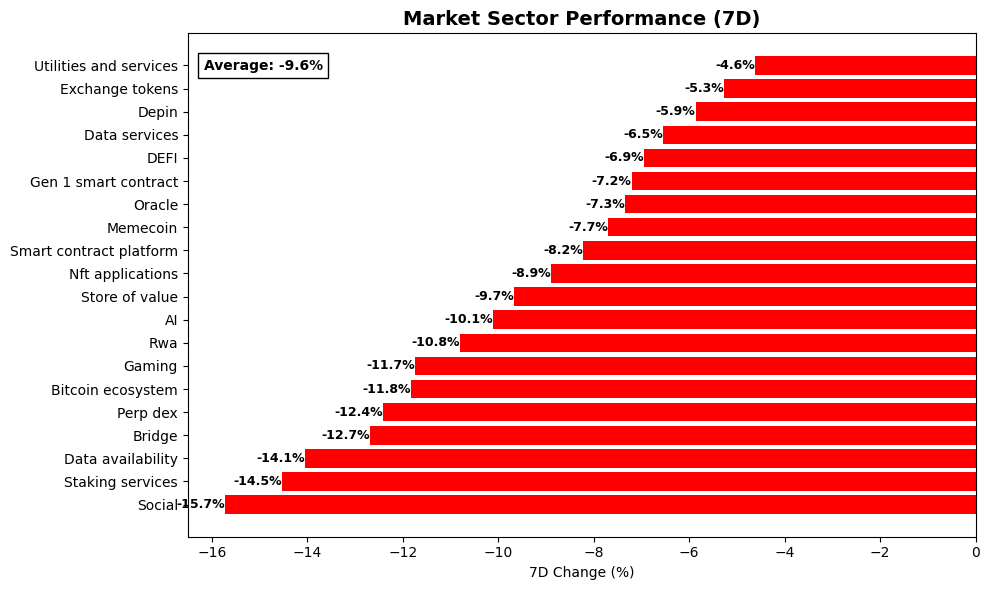
The tariff-driven sell-off saw all crypto sectors contract this week. The largest losses were in social, with staking services not far behind. Amidst the sell off, the crypto fear and index remained in extreme fear territory at 14. As crypto prices declined to start the new week, US$465 million in liquidations occurred, mostly from long positions being wiped out.
Biggest loser
- Staking services: Rocket Pool (-26.8%) continued its recent declines. The decentralised staking protocol for Ethereum 2.0 requires smaller staking amounts by pooling resources from participants. Ethereum co-founder Vitalik Buterin has previously warned against such protocols, suggesting they are susceptible to 51% attacks.
Bitcoin (BTC)
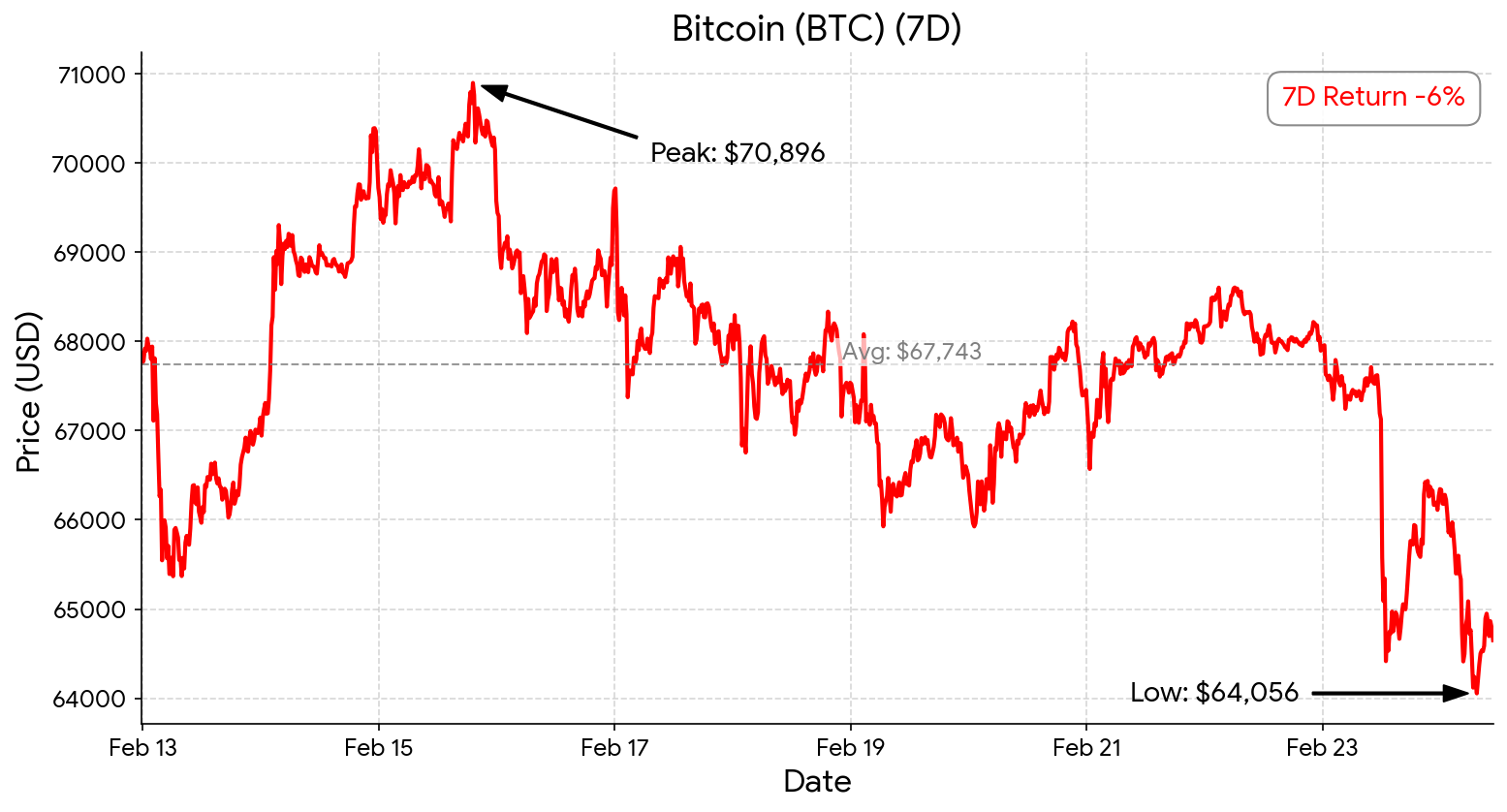
- Opened the week at US$68,792, declined to a weekly low of US$65,604 on Thursday, February 19, and rebounded on the U.S. Supreme Court’s tariff ruling. Throughout the weekend, sell pressure increased, presumably due to renewed uncertainty over President Trump’s tariffs, the high PCE reading and lower than expected Q4 U.S. GDP. Bitcoin is now trading around US$64,865 (-5.6% 7D).
- BTC dominance hovered around 59% this week.
- Bitcoin investment products saw outflows of US$215 million. Short-bitcoin saw inflows of US$5.5 million.
Bitcoin’s mining difficulty increased 15% to 144.4 trillion, marking its largest percentage increase since 2021, even as prices remain well below prior highs. The rise reflects a rebound in hashrate after recent disruptions and underscores resilient network security, though miner profitability remains under pressure at current price levels.
In bitcoin buying news:
- Strategy made its fourth-largest BTC purchase of the year on February 17, adding 2,500 BTC to its holdings. To start the new week, the company made its 100th bitcoin purchase, adding 592 BTC. This brings the company’s total bitcoin treasury to 717,722 BTC, worth almost US$54.6 billion.
- Abu Dhabi-based investment funds boosted their holdings of BlackRock’s spot Bitcoin ETF (IBIT) to more than US$1 billion by the end of 2025, according to U.S. Securities and Exchange Commission (SEC) filings. The sovereign wealth-linked entities increased exposure in Q4 even as bitcoin prices slid, underscoring continued institutional interest in regulated crypto products.
Ethereum (ETH)
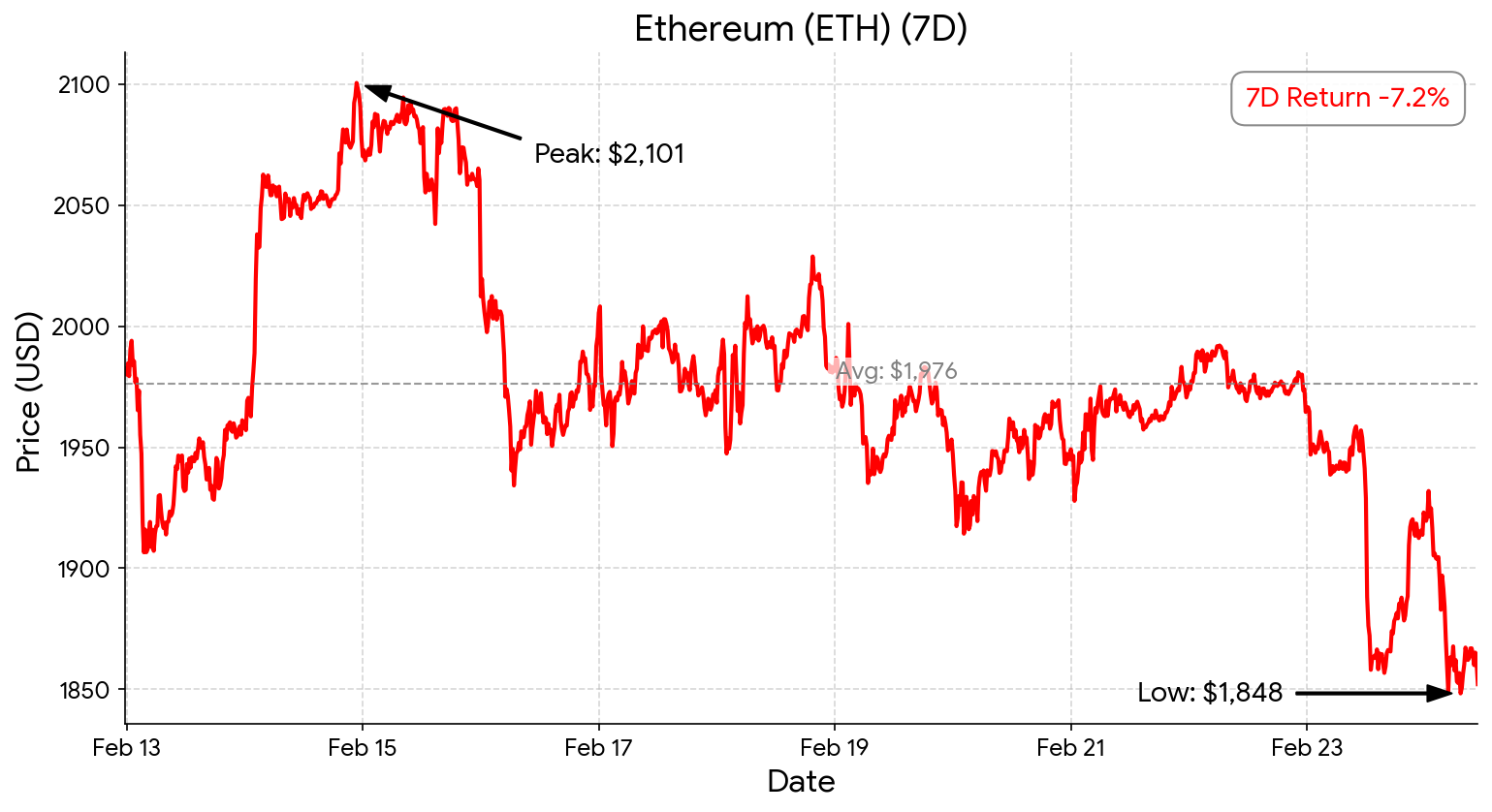
- Opened the week at US$1,965 and traded in a range just below US$1,990 for much of the week. Sell pressure picked up over the weekend, presumably due to uncertainty over tariffs and the U.S. economy. Ethereum is now trading around US$1,865 (-6.2% 7D).
- Ethereum dominance hovered between 10.2% and 10.3% this week.
- Ethereum-focused funds saw outflows of US$36.5 million.
At the Ethereum developer conference in Denver, co-founder Vitalik Buterin outlined the next network upgrade, *Hegota.* The upgrade will go live later this year. A core feature of the upgrade will be Fork-Choice Enforced Inclusion Lists (FOCIL), which are designed to force valid transactions into blocks, bolstering censorship resistance at the protocol level. Buterin says the upgrade reinforces Ethereum’s cypherpunk ethos, though some critics warn it could pose risks to validators.
Throughout the end of the week, Buterin sold over US$6 million worth of Ethereum as routine swaps of more than 3,100 ETH occurred, according to on-chain analytics. His current ETH holdings are 224,000, worth US$426 million.
In Ethereum buying news:
- BitMine bought 51,162 Ethereum, bringing its holdings to over 4.4 million ETH, worth US$8.4 billion.
- Sharplink reported that the company holds 867,798 ETH in its treasury at February 13, 2025, while the firm has seen a growing number of institutional investors. The company’s ETH holdings are worth almost US$1.7 billion.
Altcoins
The altcoin season index is currently 31, which is bitcoin season.
Morpho x Apollo
- Morpho gained almost 18%. The decentralised, non-custodial lending infrastructure that connects lenders and borrowers across numerous blockchain networks gained on news that US$938 billion asset manager Apollo Global Management will acquire up to 90 million MORPHO tokens over the next 48 months.
Short squeezes and short selling
- World Liberty Financial gained 9.8%. The Trump-linked token climbed 22% ahead of the World Liberty Forum at Mar-a-Lago. The gains were driven by whale buying and a short squeeze as crypto firm executives and political figures prepared to attend. However, these gains were short-lived as WLFI’s stablecoin, USD1 briefly slipped below its dollar peg on Binance, falling to US$0.98. WLFI declined by 7% over the same period. World Liberty claims the declines were a “coordinated attack” of hacked X accounts, disinformation and short selling.
Waning optimism
- Optimism declined by 36.2%. The layer-two Ethereum chain declined 20% on the news that Base, the Ethereum layer-2 network backed by Coinbase, said it’s dropping the Optimism OP Stack in favour of a unified, in-house technology stack to speed upgrades and cut complexity. The shift aims to accelerate development and double hard-fork cadence, and has sparked market reaction amid talk of a future Base token.
ENA declines
- Ethena declined by 20.2%. The synthetic dollar protocol built on the Ethereum network extended its recent price declines as a February 5 token unlock released almost 1.2% of supply to market, while a fall in total value locked on the network contributed to the token being down 80% year-on-year.
DC HYPE
- Hyperliquid declined by 13.9%, presumably due to persistent risk-off sentiment and leveraged liquidations. The decentralised perpetual futures exchange launched the Hyperliquid Policy Center in Washington, D.C. this week. The centre is backed by US$29 million in HYPE tokens and aims to advocate for clearer U.S. rules for decentralised finance and perpetual derivatives.
Crypto ETF News
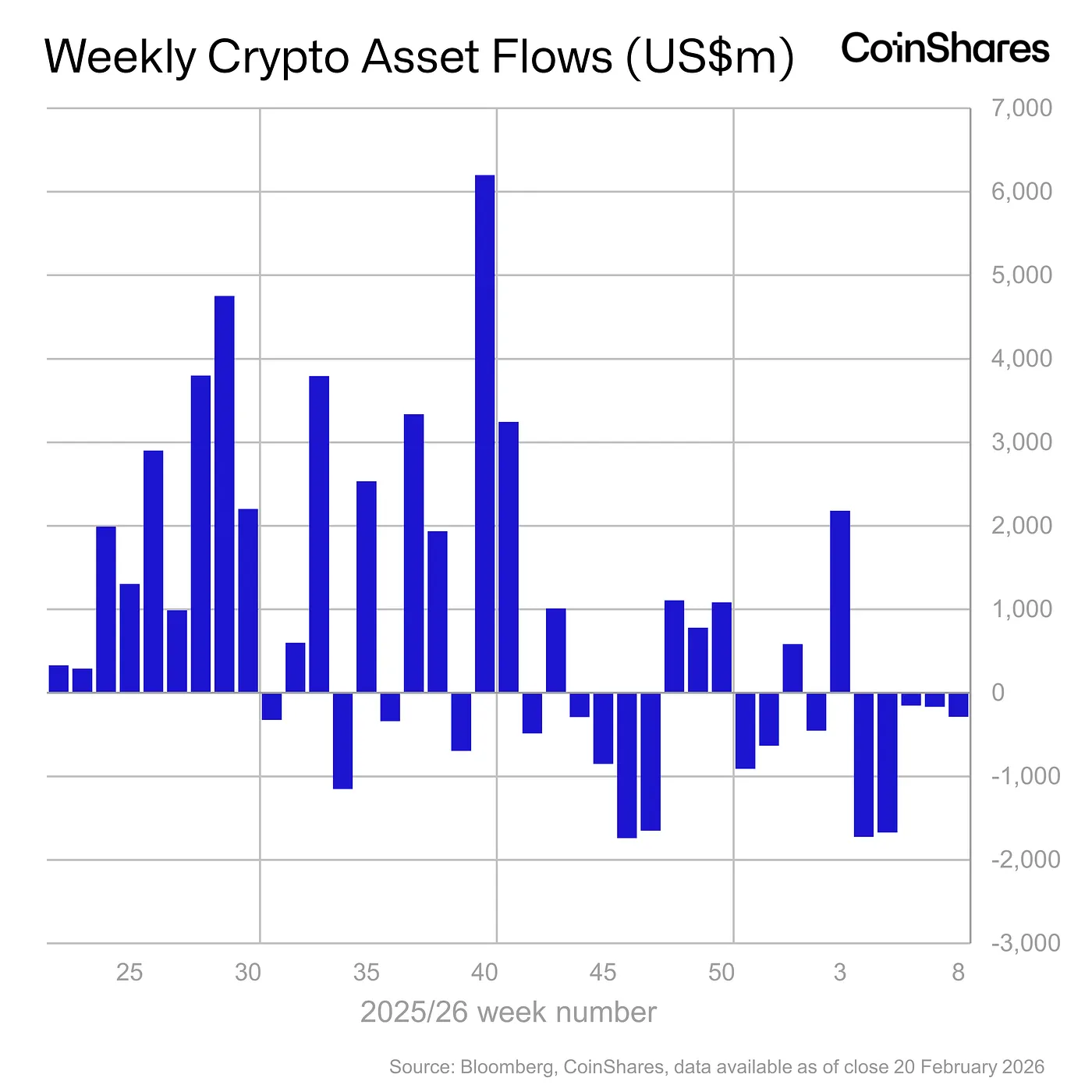
Digital asset investment products saw outflows of US$288 million on continued low volumes and macroeconomic uncertainty. Cumulative outflows over the last five weeks stands at US$4 billion.
In altcoins, XRP, Solana and Chainlink saw minor inflows of US$3.5 million, US$3.3 million and US$1.2 million, respectively.
Canary Capital’s and Grayscale’s SUI exchange-traded funds (ETFs) launched on Wednesday, February 18. Both ETF products offer staking rewards. The Canary SUI ETF (SUIS) is trading on the Nasdaq, while Grayscale converted its Grayscale SUI Trust (GSUI) into a spot ETF.
Other crypto news
- U.S. policymakers, banking representatives and crypto industry groups resumed talks at the White House on how stablecoin rewards should be treated under the Senate’s stalled digital asset market structure legislation (the CLARITY Act). The negotiations centre on whether incentives can be structured without treating stablecoin issuers as deposit institutions, which is a key sticking point for advancing the bill. Also this week, the U.S. SEC released frequently asked questions on how payment stablecoins should be treated, adding that if a broker-dealer applied a 2% discount on proprietary positions, that would satisfy the broker-dealer net capital rule. The White House has set a March 1 deadline to resolve the stablecoin rewards debate.
- U.S. Senator Elizabeth Warren pressed Treasury Secretary Scott Bessent and Federal Reserve Chair Jerome Powell to formally rule out using taxpayer funds to bail out bitcoin or crypto firms amid the recent sell offs. Warren argues government support would unfairly benefit wealthy investors and deepen risks for ordinary taxpayers. The argument comes despite liquidity facilities and similar mechanisms being core tenets in the U.S. Federal Reserve’s monetary policy agenda to control Treasury yields, currency stability, and TradFi risk asset prices—liquidity which typically flows to banks, wealthy investors and large institutions.
- California began enforcing its state-level crypto licensing regime under the Digital Financial Assets Law (DFAL), mandating that firms serving residents must obtain a license, submit an application, or qualify for an exemption by July 1, 2026. The rules, likened to New York’s BitLicense, aim to strengthen oversight and could set broader U.S. compliance norms.
- The Netherlands plans to revamp its investment tax system from January 2028, taxing actual annual returns, including unrealised gains on crypto, stocks and bonds, at about 36% under the Actual Return on Box 3 Act. Critics warn this means paying tax on paper profits even if assets aren’t sold. Investors will get a US$2,000 exemption on returns, and losses can be carried forward, but not refunded.
- Stripe’s stablecoin arm, Bridge, gained conditional approval from the U.S. Office of the Comptroller of the Currency (OCC) to form a federally chartered national trust bank, paving the way to issue and manage stablecoins, custody digital assets and handle reserves under federal supervision.
- CME Group plans to offer 24/7 trading for regulated crypto futures and options starting May 29, pending approval, aligning its derivatives markets with always-on spot crypto trading. The move aims to let institutional traders adjust exposure around the clock and mirrors wider Wall Street interest in continuous markets, boosting access and liquidity.
- Elemental Royalty, a precious metals royalties firm, will allow shareholders to receive dividends in Tether’s tokenised gold (XAUT). The option links payouts directly to blockchain-based gold ownership while still preserving cash dividends, showcasing a novel use case for tokenised real-world assets amid rising digital-gold demand. Tether continues to dominate the dollar-pegged stablecoin market, with a market cap of USD$184 billion. Shrinking equity buffers and a risky asset reserve mix are, however, raising doubts about USDT’s ability to maintain its dollar peg.
from Caleb & Brown Cryptocurrency Brokerage.


