


Market highlights
- Crypto’s total market cap declined by about 12% to US$2.7 trillion in weekend sell off.
- U.S. Senate’s crypto market structure bill passed markup vote in the Agriculture Committee.
- U.S. SEC and CFTC hosted a joint “harmonisation” event to launch “Project Crypto”.
- Tether continued expanding its US$24 billion gold reserve, with weekly purchases.
- A UAE-backed entity reportedly took 49% stake in World Liberty Financial in January.
- Arizona lawmakers advanced a bill to exempt cryptocurrencies from state property taxes.
Macro market overview
Although TradFi risk assets finished the week relatively flat, it was a turbulent week in macro uncertainty, which saw a large intraday sell off on Thursday, January 29. The sell off came as the U.S. Federal Open Market Committee (FOMC) left rates on hold at 3.75%. In other macro data, U.S. unemployment claims came in slightly above forecast at 209,000, while the core producer price index (PPI) came in well over forecast at 0.7% for the month ending December 31, 2025.
According to CME’s Fed Watch tool, the likelihood of a rate cut at the FOMC’s March 18 meeting is 8.9%. The stable employment data and higher than expected PPI reading indicates that the Fed may possibly keep rates on hold at its next meeting, lowering the likelihood of rate cuts throughout the year that could see liquidity flow to risk assets.
Mixed tech earnings, President Trump’s nomination of former Fed Governor Kevin Warsh to become the new Chair of the U.S. Federal Reserve, and instability in the U.S. Dollar’s value made for an uncertain end to the week. Warsh is considered to support minor interest rate cuts, but not the aggressively easy monetary policy some other potential nominees may have delivered. Gold and silver sold off from its recent highs, declining by 9% and 26.2%, respectively, in Friday’s trading. The ten-year yield finished the week slightly elevated at 4.2%.
Weekly performance: S&P 500 +0.3%, Dow Jones -0.4%, Nasdaq -0.2%.
Looking ahead:
- U.S. ISM Manufacturing PMI - Tuesday, February 2
- Reserve Bank of Australia rate decision - Tuesday, February 2
- Bank of England rate decision - Thursday, February 5
- U.S. non-farm employment change - Friday, February 6
Crypto Market Performance
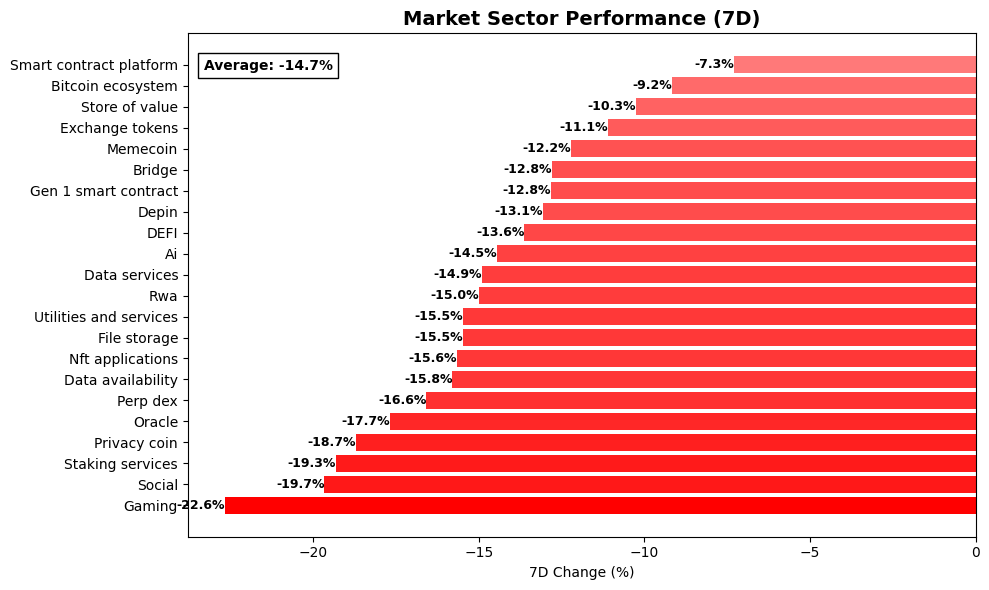
All sectors saw declines this week, with gaming making the steepest losses, while smart contract platforms experienced the smallest decline. The prospect of U.S. monetary policy being tighter than expected throughout 2026, U.S. Dollar instability, mixed tech earnings, and the sell off across precious metals saw the crypto market decline throughout the weekend. Crypto’s total market value has decreased by almost US$2.7 trillion throughout the sell off, while total liquidations peaked at almost US$2.6 billion on January 31. The crypto fear and greed index is currently in extreme fear territory at 15.
Bitcoin (BTC)
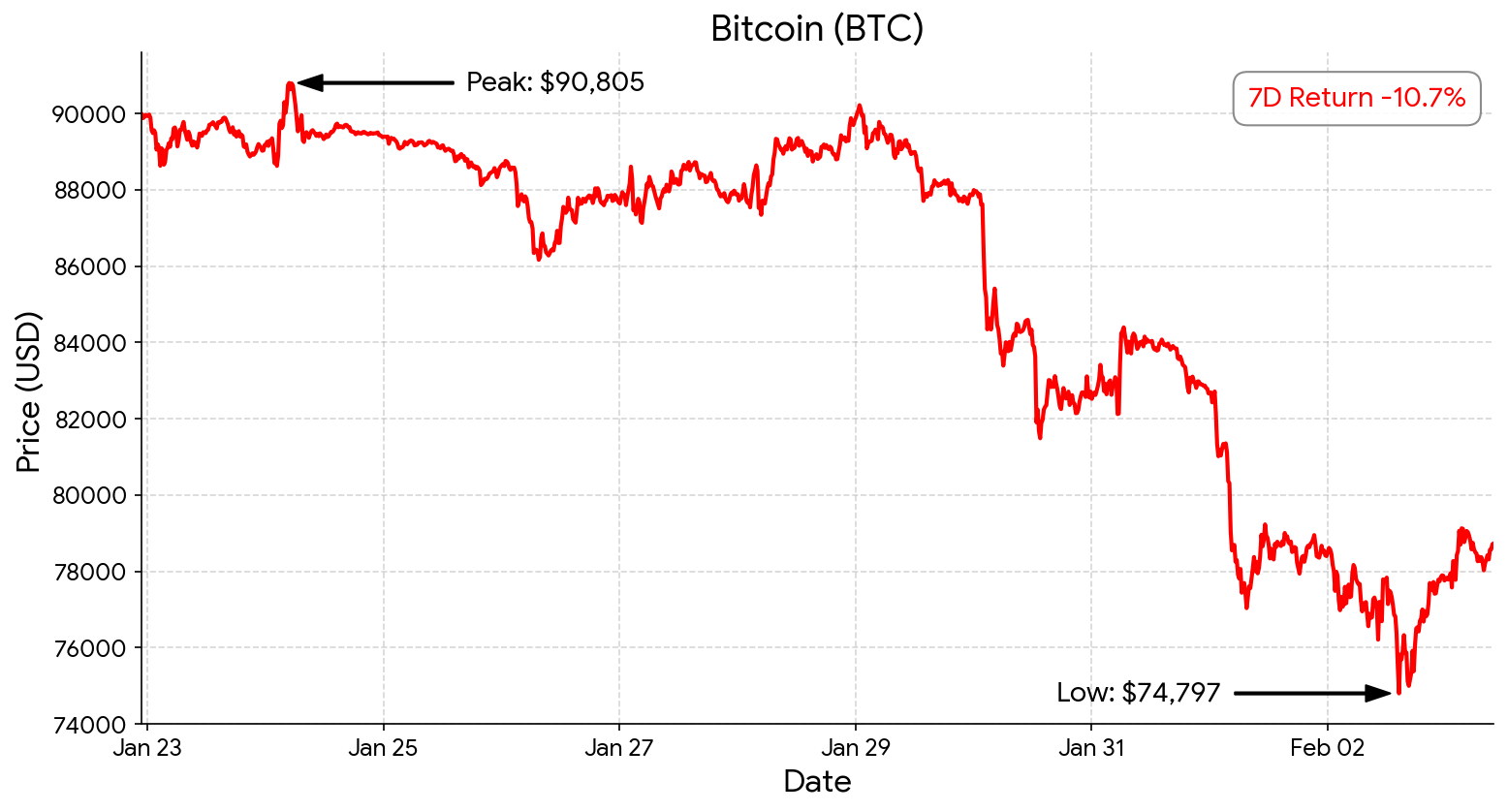
- Opened the week at US$86,561, and experienced a sharp sell off on the potential for tighter than anticipated monetary policy, the sell off in precious metals, mixed U.S. Dollar performance, and broader global macro uncertainty. Falling 7% over the weekend, bitcoin saw US$800 million in liquidated positions as prices moved down to levels not seen since April 2025 around the “Liberation Day” tariff announcements. Bitcoin hit a 9-month low of US$75,644 on Saturday, January 31 and is now trading around US$78,500 to start the new week (-10.9% 7D).
- BTC dominance hovered between 59.9% and 59.4% this week.
- Bitcoin investment products saw outflows of US$1.3 billion. Short-bitcoin saw inflows of US$14.5 million — a year to date increase of 8.1%.
A South Dakota lawmaker reintroduced legislation to create a state bitcoin reserve, allowing the state to allocate up to 10% of its funds to a BTC treasury, either through spot holdings or exchange-trade fund (ETF) exposure. The proposal comes as South Dakota’s investment fund under-performed in 2025, delivering a 5.5% return on its almost US$20.6 million in assets under management.
In bitcoin buying news:
- Metaplanet closed a US$137 million raise, via the sale of 24.5 million shares and one-year warrants, to buy more bitcoin. The firm currently holds 31,102 BTC, worth US$3 billion.
- Strive Asset Management bought 333 BTC, bringing its holdings to 13,132 BTC, worth US$1.1 billion. The firm is now in the top-10 publicly-traded bitcoin holders, and paid off about 92% of its debt related to the recent acquisition of Semler Scientific.
- Strategy bought 855 bitcoin, bringing its total holdings to 713,502 BTC at an average purchase price of US$76,052 per bitcoin. Notably, Strategy’s BTC returns briefly in the negative, based on the company’s average buy price. The company’s stock is also now trading at a discount to its BTC holdings.
Ethereum (ETH)
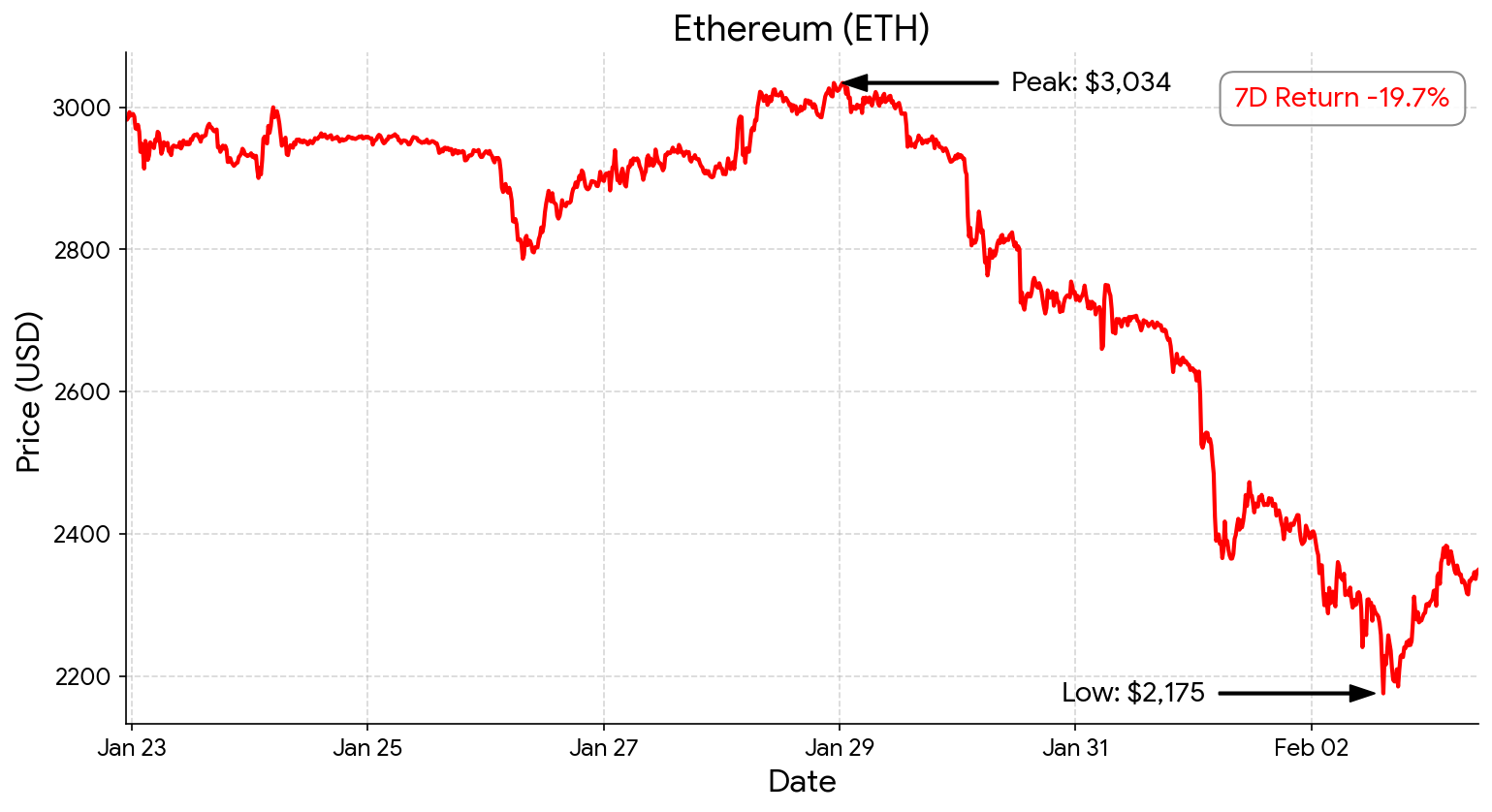
- Opened the week at US$2,814, and sold off on risk-off sentiment. Ethereum is now trading around US$2,340 to start the new week (-20% 7D).
- Ethereum dominance hovered between 11.8% and 10.8% this week.
- Ethereum-focused funds saw outflows of US$308 million.
Vitalik Buterin, Ethereum’s co-founder withdrew 44.7 million ETH, worth US$80 billion from his long-term holdings to support ecosystem growth under a proposed “mild austerity” plan. The strategy aims to redirect funds toward public goods, protocol development and sustainability initiatives while reducing reliance on speculative price action for funding.
Around 75,000 ETH left over from unresolved DAO contracts will be re-directed into a US$220 million security fund for the network. The fund is part of an earlier plan agreed to by Ethereum’s founders to use unclaimed funds for ecosystem defence. Governance of the fund will rely on community-driven grant mechanisms rather than core developer oversight.
Fidelity launched the “Ethereum Digital Dollar”, a U.S.-dollar-pegged token designed for institutional settlement on Ethereum. The offering aims to combine bank-grade reserves with on-chain utility for trading, payments and DeFi.
In Ethereum buying news:
- Bitmine bought 41,788 ETH, bringing its total holdings to almost 4.3 million (over 3.5% of ETH’s supply), worth around US$9.9 billion.
Altcoins
The altcoin season index is currently at 41, which is still bitcoin season.
HYPEd up
- Hyperliquid gained 34.2%. The decentralised perpetual futures exchange (perp DEXs) saw gains on a boost in on-chain volume for gold and silver, the announcement of its prediction market outcome trading in its upcoming HIP-4 launch, and presumably clarification around regulatory oversight of perp DEXs.
Privacy wins
- Canton continued last week’s gains, rising 22.4%. The public blockchain for regulated entities presumably saw gains as BlackRock took a 2.2% stake (worth US$100 million) in Tharimmune, the publicly traded company building a Canton Coin digital asset treasury.
Sad story
- Story declined by 31.9%. The losses came on news that the team delayed its next token supply unlock by six months due to risk-off sentiment and the need for time to revise its token economics and grow network usage.
Sad face
- Immutable lost 22.9%. The blockchain designed to scale Ethereum for non-fungible tokens (NFTs) and gaming presumably saw declines amid the broader market sell off. The team, in partnership with Crypto Blockchain Industries, launched a public demo of emoji Marble Dash in the Epic Games Store this week.
Stake in the game
- Optimism declined by 22.9%. The layer-two Ethereum scaling network saw declines as it announced changes. The community approved a plan to use 50% of Superchain revenue to buyback OP tokens over the next year. The team also launched OP Enterprise this week, which is a blockchain suite for fintechs. Finally, the network announced it will transfer 6,400 ETH to enable staking of its Optimism Collective treasury assets.
Sui declines
- Sui declined by 20.9%. The layer-1 network struggled to maintain strength as the broader crypto market sold off throughout the weekend, although whales have reportedly continued to accumulate throughout the dip. The network’s recent alpha update promises private transactions and free stablecoin transfers.
Crypto ETF News
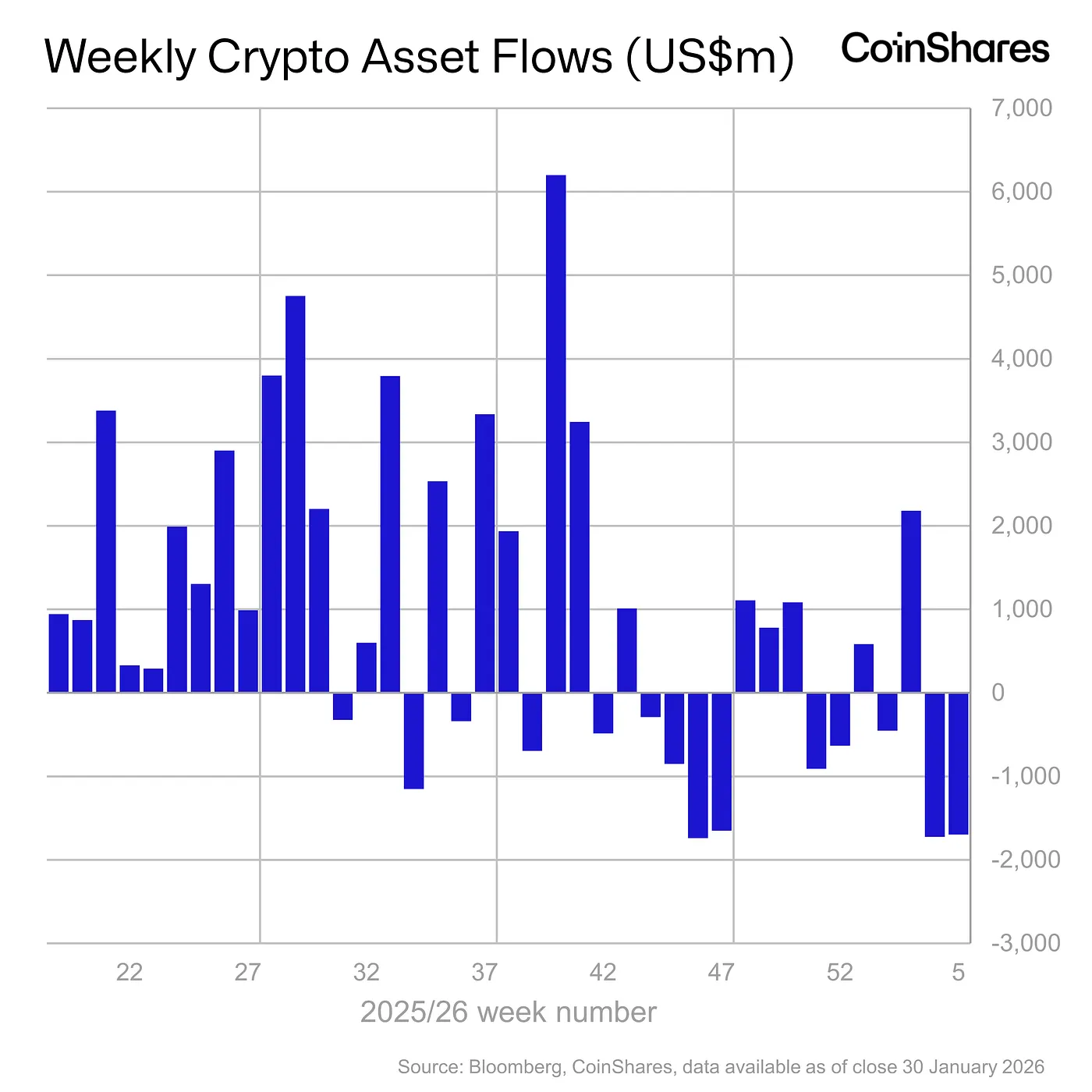
Digital asset investment products saw outflows of US$1.7 billion as risk-off sentiment accelerated. Year to date flows have now flipped negative, with a net outflow of US$1 billion.
In altcoins, XRP and Solana saw outflows of US$43.7 million and US$31.7 million, respectively. Hype investment products bucked the trend, with US$15.5 million if inflows due to increasing volume in on-chain sales of tokenised precious metals.
Exchange-traded fund (ETF) issuer, VanEck launched the first U.S. spot Avalanche ETF (VAVX). The fund offers exposure to spot AVAX performance and staking rewards. Also this week, Bitwise formed a Delaware statutory trust for a possible Uniswap ETF.
Other crypto news
- President Trump nominated former Fed Governor Kevin Warsh to lead the U.S. Federal Reserve after Jerome Powell’s term ends on May 15. Warsh has signalled a more market-friendly stance toward digital assets, emphasising the need for innovation and regulatory clarity in past speeches. His position suggests potential openness to crypto-related financial infrastructure, but he’s not expected to deliver the aggressive rate-cutting agenda that other potential nominees may have instated, which may have seen more liquidity flow into crypto.
- A UAE-backed entity with ties to Sheikh Tahnoon bin Zyed reportedly agreed to buy a 49% stake in Trump-linked World Liberty Financial for US$500 million for days before the president’s inauguration. The proceeds flowed to the Trump and Witkoff family entities before the U.S. shifted its policy on U.S. advanced AI chips, expanding access to the UAE. The reports have raised ethical concerns amongst policymakers.
- The U.S. Senate’s crypto market structure bill passed a 12-11 markup vote in the Agriculture Committee on Thursday, January 29. Once enacted, the bill will clarify regulatory roles for the U.S. Securities and Exchange Commission (SEC) and Commodities and Futures Trading Commission (CFTC), establish registration and investor protections for trading platforms, and modernise oversight over digital assets. The bill now needs to clear the Senate Banking Committee before it heads to a vote on the Senate floor.
- U.S. SEC Chair Paul Atkins and CFTC Chair Mike Selig hosted a joint “harmonisation” event at the CFTC’s headquarters to launch “Project Crypto”. The project is the largest ever inter-agency effort to provide regulatory clarity around digital assets. Atkins says “the time is right” to allow retirement plans, including 401(k)s to include crypto, while Selig outlined rules for tokenised collateral, on-shoring perpetuals, safe harbours for developers, a new registration category for retail leveraged crypto trading, and new rules for prediction markets.
- Tether has continued expanding its US$24 billion gold reserve, purchasing one to two tons per week. CEO Paolo Ardoino says the strategy diversifies backing for the company’s asset coverage and strengthens confidence in its reserve portfolio, even as regulatory scrutiny of stablecoin collateral remains elevated. Also this week, Tether launched its USAT stablecoin, which is issued by Anchorage Digital and aims to be compliant with the GENIUS Act. Plus, the network reported a record US$10 billion net profit in 2025, with a record US$141 billion in U.S. Treasury exposure.
- Nomura-owned Laser Digital filed with the U.S. Officer of the Comptroller of the Currency for a U.S. national banking charter for its crypto-focused subsidiary. If approved, the charter will allow the bank to offer regulated custody, trading and tokenised asset services under federal supervision.
- Arizona lawmakers have advanced a bill to exempt cryptocurrencies from state property taxes, treating digital assets like traditional securities rather than taxable property. The measure will appear on ballots in November, where citizens will need to vote on amending Arizona’s constitution to exempt virtual currency from property taxation.
- The Australian Securities and Investments Commission (ASIC) has placed crypto markets on its 2026 “risk list,” highlighting oversight gaps in trading, custody and disclosure. The warning underscores calls for stronger regulation to align digital-asset markets with traditional financial protections. Crypto regulation in Australia has historically lagged behind the rest of the world, without any proactive moves from regulators to provide legislative clarity or foster innovation.
from Caleb & Brown Cryptocurrency Brokerage.


