


Market highlights
- American Bitcoin reported a US$59.5 million net loss in Q4 2025.
- Ethereum’s core researchers published a draft “strawmap” through to 2029.
- The Ethereum Foundation began staking part of its ETH treasury, initially locking ~2,106 ETH.
- The U.S. OCC released proposed stablecoin rules under the GENIUS Act.
- Arizona’s state Senate advanced a bill to establish a Digital Assets Strategic Reserve Fund.
- Terraform Labs’ bankruptcy estate filed a lawsuit against trading firm Jane Street.
Macro market overview
The major U.S. indexes ended the week down as heavyweight tech stocks declined on continued concerns around the capital expenditure (capex) required to expand artificial intelligence (AI) capabilities. Friday’s producer price index (PPI) reading, which came in above forecast at 0.5% month-on-month, and 2.9% for the 12 months ending January 31, 2026, could also give the U.S. Federal Open Market Committee (FOMC) reason to keep rates on hold at its March 17 meeting. CME’s FedWatch tool currently places the probability of a 25-basis-point cut in March at 2.5%.
Despite last week’s reports of talks progressing between Iran and the U.S., Israel and the U.S. carried out military strikes on Iran over the weekend, which resulted in the death of Iran’s Supreme Leader, Ayatollah Ali Khamenei. The attacks have also effectively closed the Strait of Hormuz, a major channel that transports 20% of the world’s oil supply. Iran retaliated by striking U.S. assets across the Middle East, and further strikes on Iran have continued into the new week.
Precious metals gained on escalating geopolitical tension, with gold and silver rising 4.7% and 9%, respectively, on the week. U.S. Treasury Yields declined throughout the week. The U.S. two-year yield declined to 3.4%, while the ten-year yield closed just below 4%, indicating that capital is flowing to safe-haven assets. U.S. oil jumped almost 12% on March 1 to around US$75 a barrel, and is now trading around US$71.
The U.S. ISM manufacturing purchasing manager’s index (PMI) came in above forecast at 52.4—a second month of a reading above 50, which represents potential economic expansion. This week, market participants will presumably be watching for further developments in geopolitical tensions and the U.S. non-farm employment change.
Weekly performance: S&P 500 -0.4%, Dow Jones -1.1%, Nasdaq -0.4%.
Looking ahead:
- U.S. non-farm employment change - Friday, March 6.
Crypto Market Performance
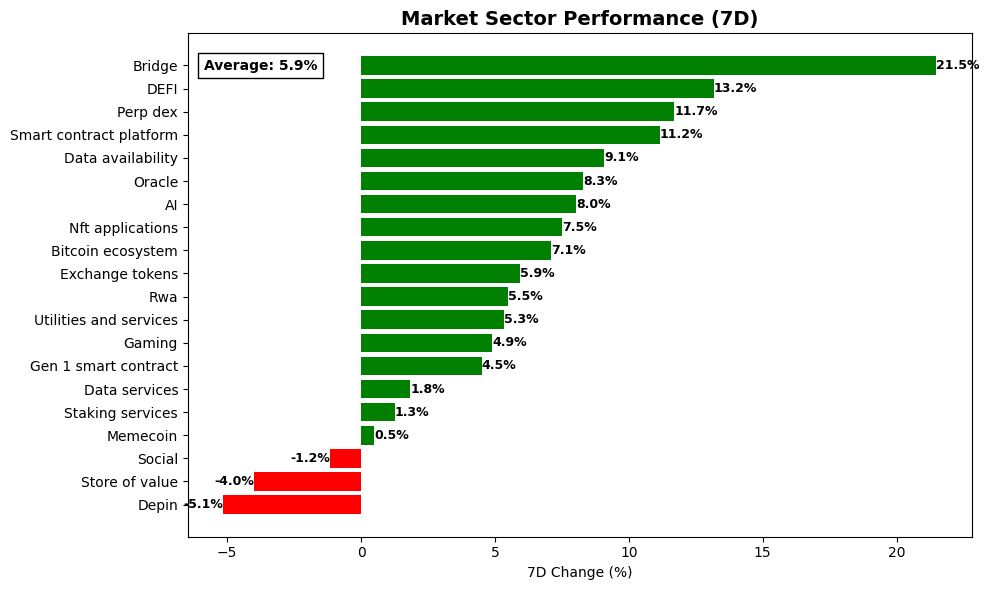
Most crypto sectors saw gains this week as the recent sell pressure subsided. Bridging services saw the biggest gains, while decentralised physical infrastructure networks (DePIN) saw the largest declines. Despite small signs of strength this week, the crypto fear and greed index remains in extreme fear territory at 15.
Biggest winner
- Bridging services: LayerZero (+25.2%) made gains as omnichain projects saw upwards momentum to start the new week. The team’s decentralised autonomous organisation (DAO) confirmed that it had burned all remaining $STG tokens, finalising the rebrand from Stargate to LayerZero. Stargate was acquired by LayerZero in August 2025.
Bitcoin (BTC)
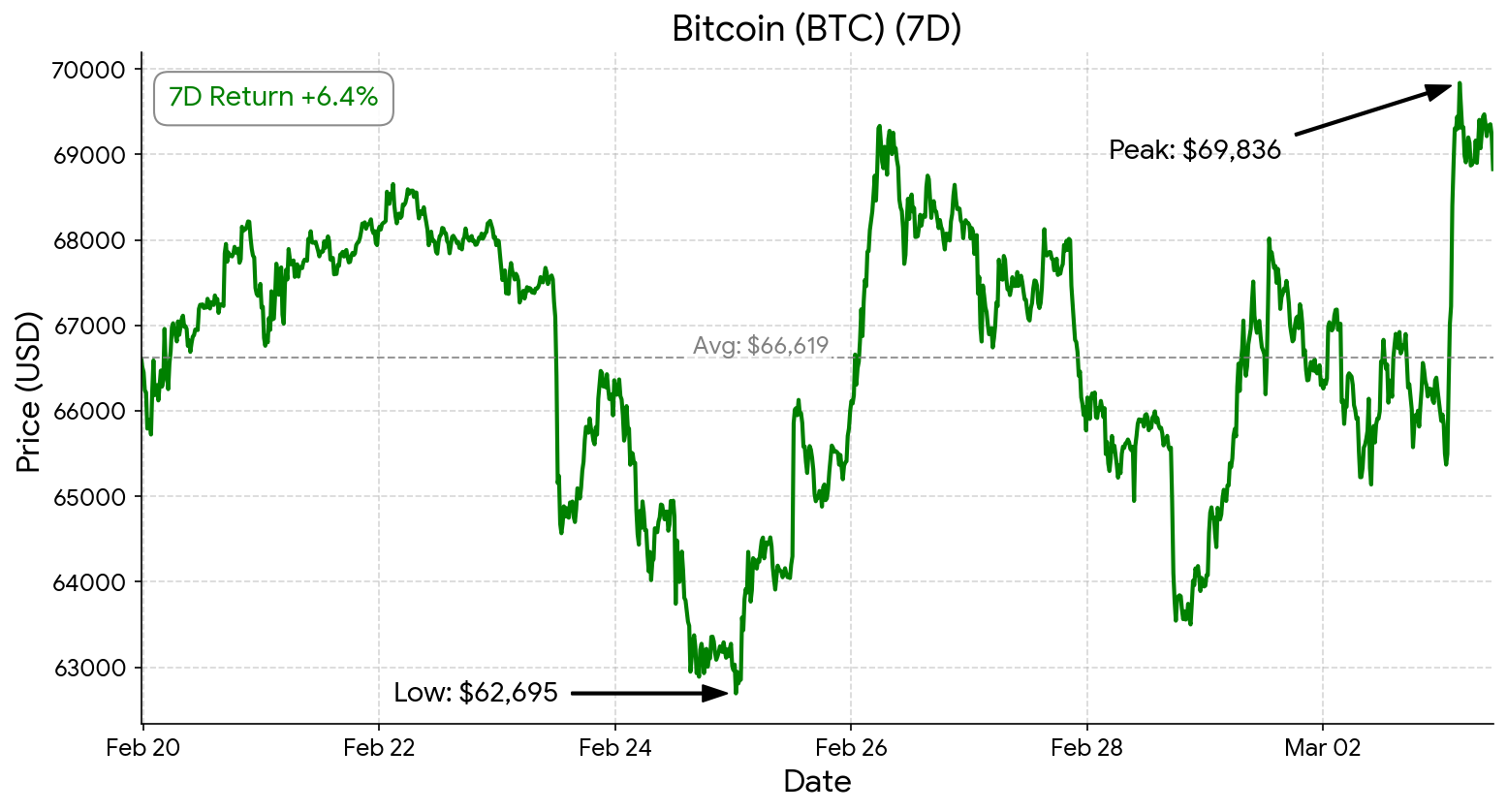
- Opened the week at US$67,616 declined to a low of US$62,534 on Tuesday, February 24, and made gains in the new week, as capital flows into select assets, such as precious metals and crypto as the U.S. and Israel’s joint conflict with Iran escalates. Bitcoin is now trading around US$69,300 (+7.5% 7D).
- BTC dominance ranged between 59% and 58.5% this week.
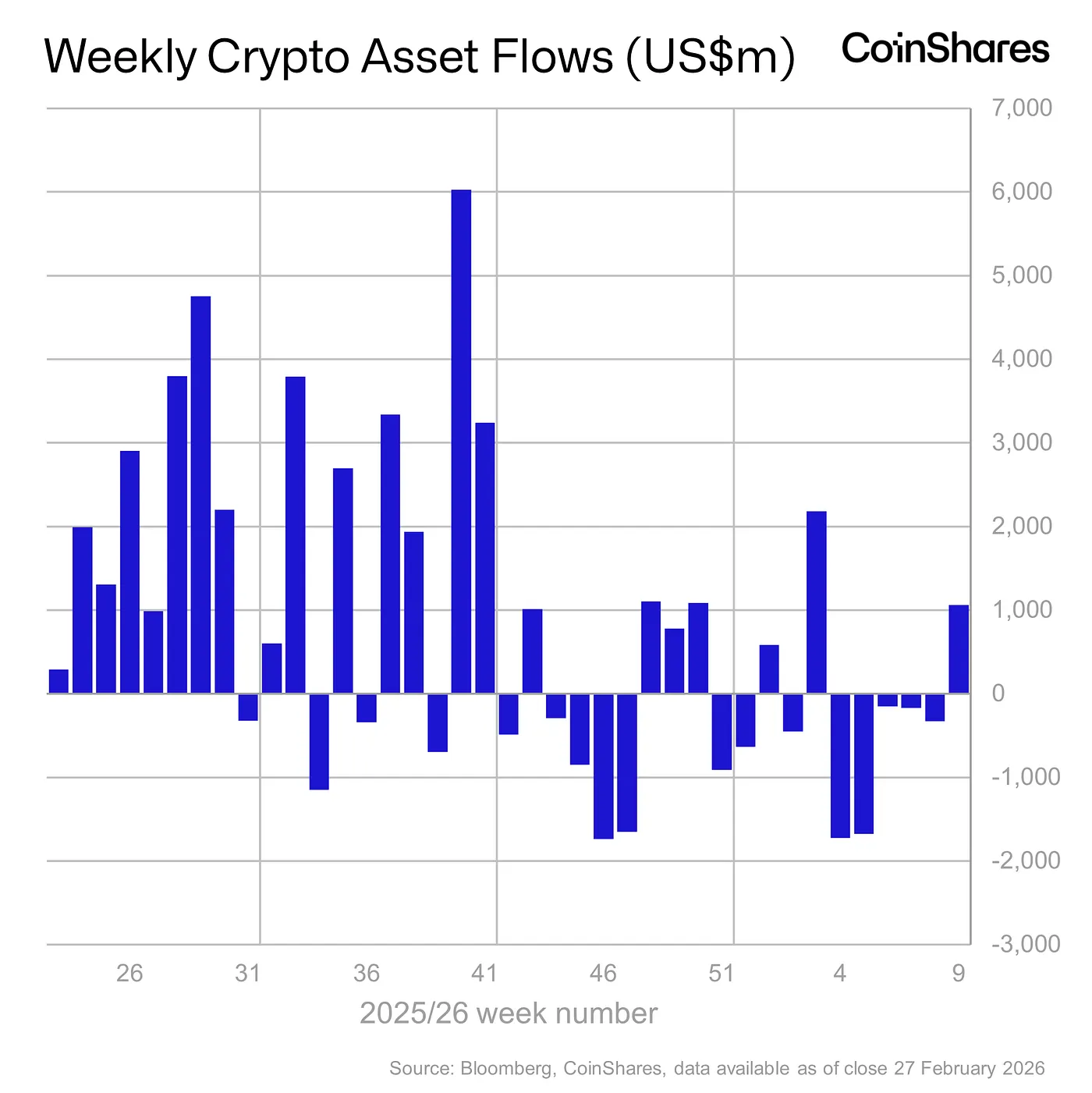
- Bitcoin investment products saw inflows of US$881 million.
American Bitcoin, the bitcoin mining company co-founded and backed by Eric Trump and Donald Trump Jr., reported a US$59.5 million net loss in Q4 2025, reversing a profit from the prior year as bitcoin prices slid. Revenue narrowly missed estimates and the company’s stock price has declined 39% in the year to date.
In bitcoin buying news:
- Strategy bought 3,015 BTC, bringing its total holdings to 720,737 BTC at an average purchase price of US$75,985 per bitcoin.
Ethereum (ETH)
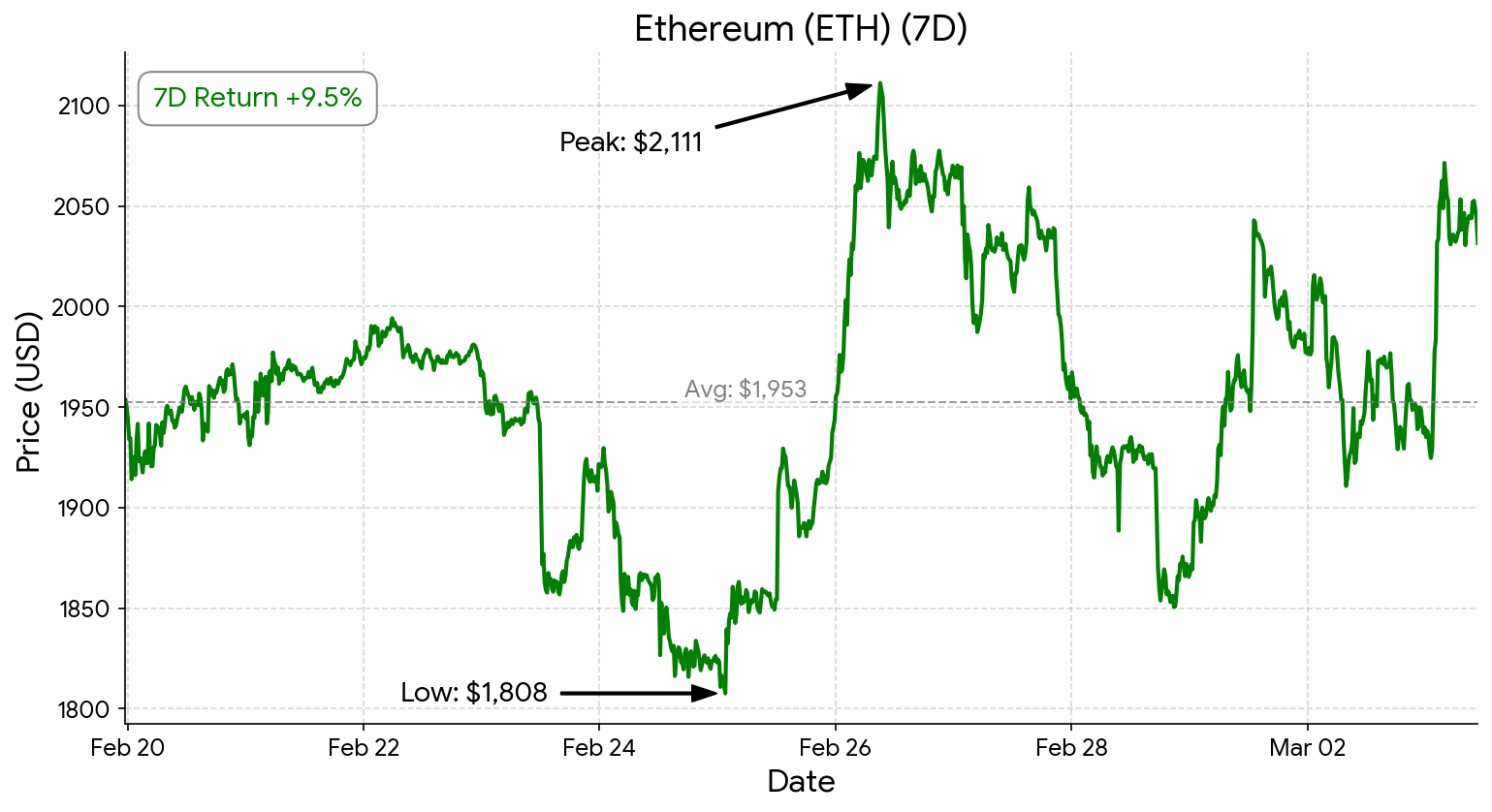
- Opened the week at US$1,956, declined to a low of US$1,800 on Tuesday, February 24, and then made gains to start the new week as crypto sentiment improved. Ethereum is now trading around US$2,050 (+9.8% 7D).
- Ethereum dominance ranged between 10.3% and 10.2% this week, with a brief spike to 10.8% on Wednesday, February 25, presumably as the Ethereum Foundation unveiled the network’s seven-fork “strawmap” through to 2029.
- Ethereum-focused funds saw inflows of US$117 million, the largest inflows since mid January.
Ethereum co-founder Vitalik Buterin outlined a “quantum upgrade” roadmap to safeguard the network against future quantum-computing threats by gradually replacing vulnerable cryptographic components, including BLS, ECDSA and KZG, with quantum-resistant alternatives. His phased plan, supported by the Ethereum Foundation’s post-quantum team, aims to future-proof core security without disrupting the protocol.
Also this week, Ethereum’s core researchers, led by the Ethereum Foundation, published a draft “strawmap” outlining seven proposed hard forks through to 2029, roughly one every six months. The plan targets major Layer 1 improvements, including faster block times, near-instant finality, higher throughput, native privacy and post-quantum cryptography.
Treasury firm, ETHZilla is rebranding as Forum Markets with a new Nasdaq ticker FRMM as it shifts focus toward tokenising real-world assets. The move follows investor exits and a steep collapse in its share price after its crypto balance-sheet strategy faltered due to declining ETH prices in recent months. The company’s stock price gained 13.3% on the news.
The Ethereum Foundation began staking part of its ETH treasury, initially locking ~2,106 ETH. The Foundation plans to stake up to 70,000 ETH to generate yield for funding research, grants and operations. The move coincides with co-founder Vitalik Buterin’s recent ETH sales, which are also intended to help finance the foundation.
In Ethereum buying news:
- BitMine bought 50,928 Ethereum, bringing its holdings to almost 4.5 million ETH, worth US$8.8 billion.
Altcoins
The altcoin season index is currently 36, which is bitcoin season.
AI gains
- NEAR Protocol gained 40%. The layer-1 blockchain designed for AI agents to act on behalf of users as AI-focused projects saw outsized gains compared to the broader crypto market. The team recently launched an AI super app, Near.com, that aggregates cross-chain swaps, privacy tools and smart contracts into a single user layer.
- Virtuals Protocol gained 30.3%. The decentralised infrastructure protocol that enables AI agents to operate autonomously presumably saw gains as AI-focused projects rallied into the new week. A spike in spot buying also buoyed price.
Market moves
- Hyperliquid gained 23.5%. The 24/7 decentralised perpetuals platform saw gains as market participants looked for ways to trade on the escalating conflict in Iran.
Wall Street goes DeFi
- Morpho gained 21.6%. The decentralised lending protocol saw gains following recent partnerships with Wall Street firms, including Apollo and BlackRock. Circle’s strategic USDC launch on the network presumably added to the upward momentum.
Noah’s wallet
- Jupiter gained 20.7%. The Solana-based decentralised exchange announced its partnership with Noah, a global payments infrastructure provider, which presumably buoyed prices.
Hard cap
- Aptos gained 20%. The layer-1 blockchain presumably saw gains on the passage of a vote to cap the total supply of APT tokens at 2.1 billion. There are currently 780.5 million APT tokens in circulation.
Crypto ETF News
Digital asset investment products saw inflows of US$1 billion, breaking the five-week outflow streak that saw US$4 billion leave funds.
In altcoins, Solana and Chainlink saw inflows of US$53.8 million and US$3.4 million, respectively.
Other crypto news
- The Office of the Comptroller of the Currency (OCC) released proposed rules to implement under the GENIUS Act that would limit stablecoin yield rewards being passed to users, potentially affecting Coinbase’s USDC rewards program with Circle. Experts are divided on how restrictive the language is, and the proposed rules are still subject to change following the 60-day public comment period.
- A bipartisan group of U.S. lawmakers introduced the Promoting Innovation in Blockchain Development Act, which would amend criminal law to shield DeFi software developers from prosecution when they don’t control users’ funds. The measure goes further than similar language in the Senate’s stalled crypto market structure bill, though that legislation could still include protections too.
- The UK’s Financial Conduct Authority selected four firms, including Revolut, Monee Financial Technologies, ReStabilise and VVTX, to join a stablecoin regulatory sandbox, letting the companies trial issuance and related products without penalties. The live tests will help shape the UK’s final stablecoin rules expected to be established later this year.
- Arizona’s state Senate advanced a bill to establish a Digital Assets Strategic Reserve Fund, enabling the state treasurer to hold, invest and lend seized cryptocurrencies, including bitcoin, XRP, stablecoins and non-fungible tokens. The bill will now proceed to a full legislative vote. It follows Governor Katie Hobb’s veto of an almost identical bill in 2025.
- Terraform Labs’ bankruptcy estate filed a lawsuit against trading firm Jane Street, alleging it used non-public information to execute profitable trades and worsen the May 2022 TerraUSD/LUNA collapse. The complaint claims coordinated withdrawals ahead of the stablecoin’s de-peg accelerated the downturn. Jane Street denies any wrongdoing. Terra Luna Classic (LUNC) gained 15.5% on the news.
- Circle’s stock climbed 20% after reporting USDC circulation is up 72% year-over-year to US$75.3 billion in Q4, driving a 77% revenue increase and strong transaction volume growth. The earnings beat expectations, underpinning investor optimism around stablecoin adoption despite broader crypto market weakness.
- MetaMask and Mastercard began a nationwide rollout of the MetaMask debit card in the United States, letting users spend self-custodied crypto at millions of Mastercard-accepted merchants. The card converts crypto to fiat at checkout and includes free and premium tiers with on-chain rewards.
from Caleb & Brown Cryptocurrency Brokerage.


